Best Fashion PLM and Sample Approval Platforms for 2026: 8 Tools Compared
Compare the leading fashion PLM and product development platforms for managing tech pack handoffs, vendor sample review and approval workflows, and collection status reporting without scattered links.
Key takeaways
- The platforms cover different scopes: Centric PLM, Lectra Kubix Link, and DeSL PLM cover broad product-lifecycle and enterprise processes. WFX PLM, Backbone, Uphance, and Lifecycle connect apparel product-development work with supplier, operations, or production workflows. CLO-SET is a focused fashion product-development workspace connecting style and Colorway context, 3D review, Versions, digital assets, Comments and Annotations, Workflow and Status, and Tech Pack information. It is particularly relevant to teams evaluating PLM-related workflows when 3D product development, browser-based review, product information, and apparel-specific collaboration are central requirements.
- Disconnected records can slow sample review: Sample comments, BOM changes, and measurements scattered across email, static spreadsheets, and file links can make it harder to keep decisions and collection milestones current.
- Compare feedback in context: Check how each platform connects comments and review decisions to the sample, measurement, Style, or product record, and test how internal and external users act on that information.
- Scope implementation before choosing: Deployment depends on migration, integrations, configuration, and training. Ask vendors for a timeline and plan based on your requirements rather than assuming a cloud product deploys in days or weeks.
The breakdown of sample approval and Tech Pack handoffs in apparel
A seasonal range creates related records across styles, colorways, sizes, and sampling rounds. Map the actual measurements, components, review roles, and approval steps in your collection before comparing systems.
| Disconnected handoff | Connected product-development workflow |
|---|---|
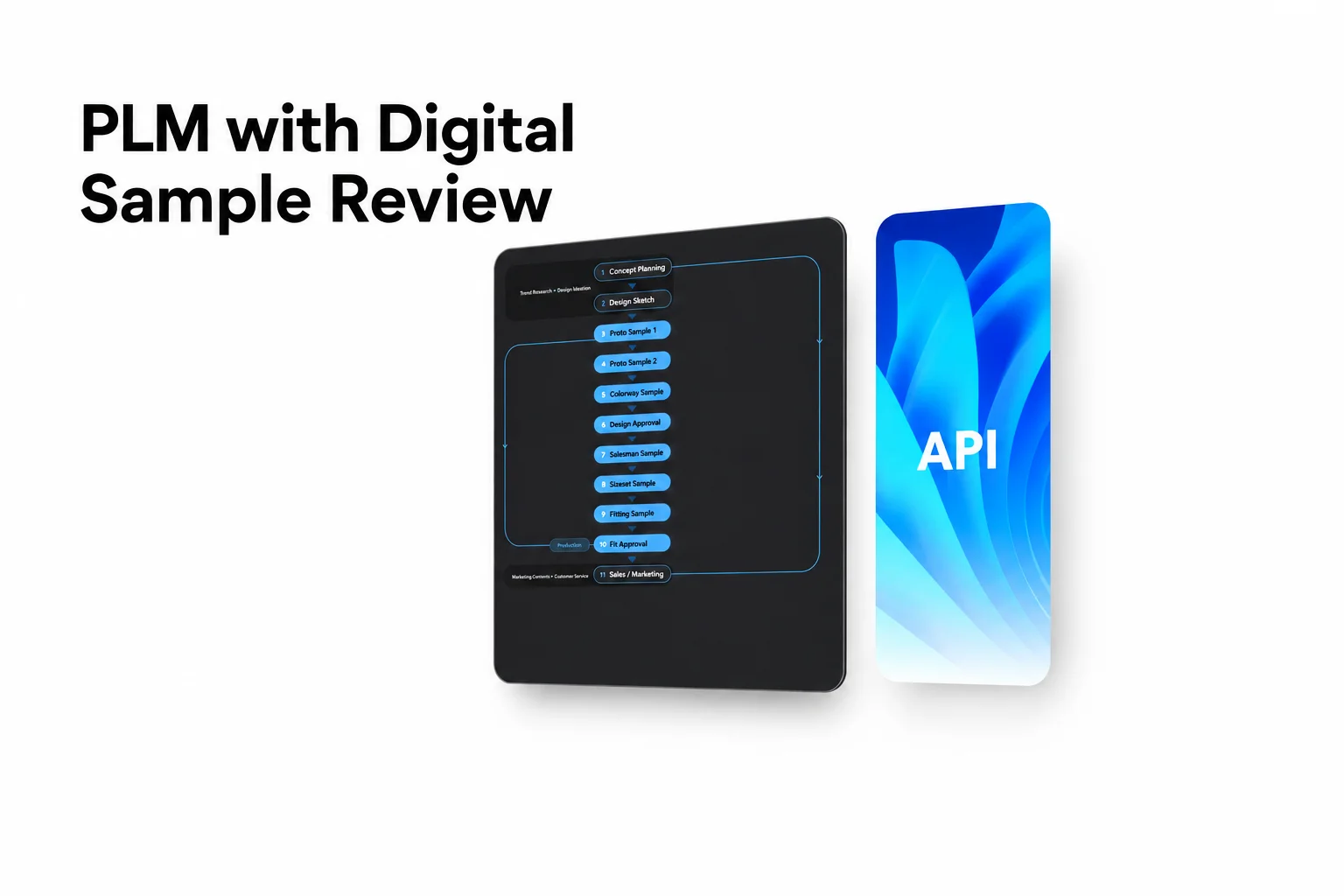
| Design / 3D Garment Development → Static PDF export → Email or shared drive → Vendor questions → Spreadsheet fit log | 3D asset or digital Tech Pack → Shared product workspace → Vendor review and status update → Feedback, revision, and decision history |
When teams manage product information through static spreadsheets, PDF exports, and fragmented cloud-storage links, three recurring problems can appear:
- Version desynchronization: A technical designer updates a point of measure (POM) or trim reference in an internal file, while a manufacturing partner works from an earlier PDF attachment.
- Disconnected sample feedback: Fit photos, rendered views, and pattern comments sit in different chat threads and email chains, separated from the relevant product information.
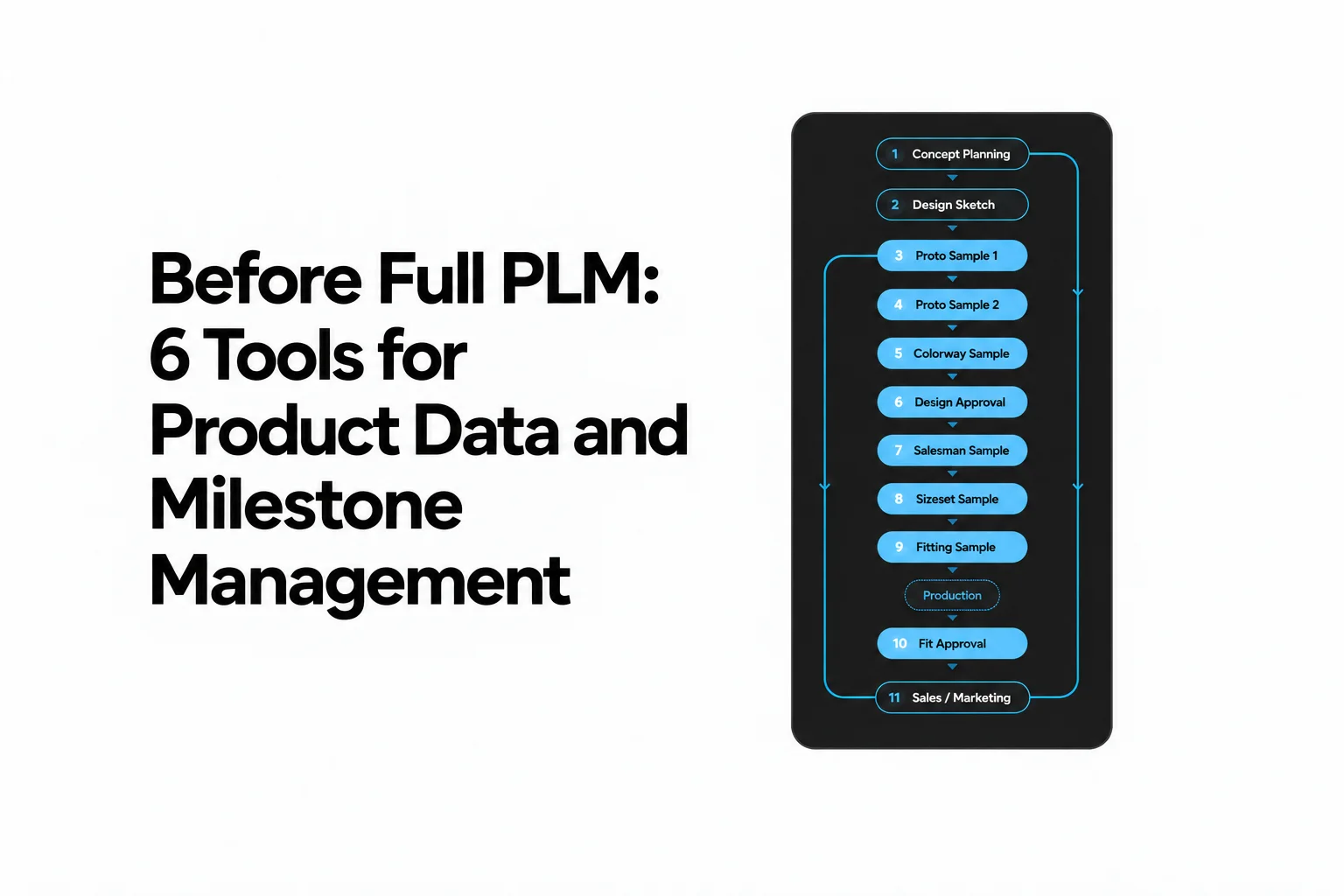
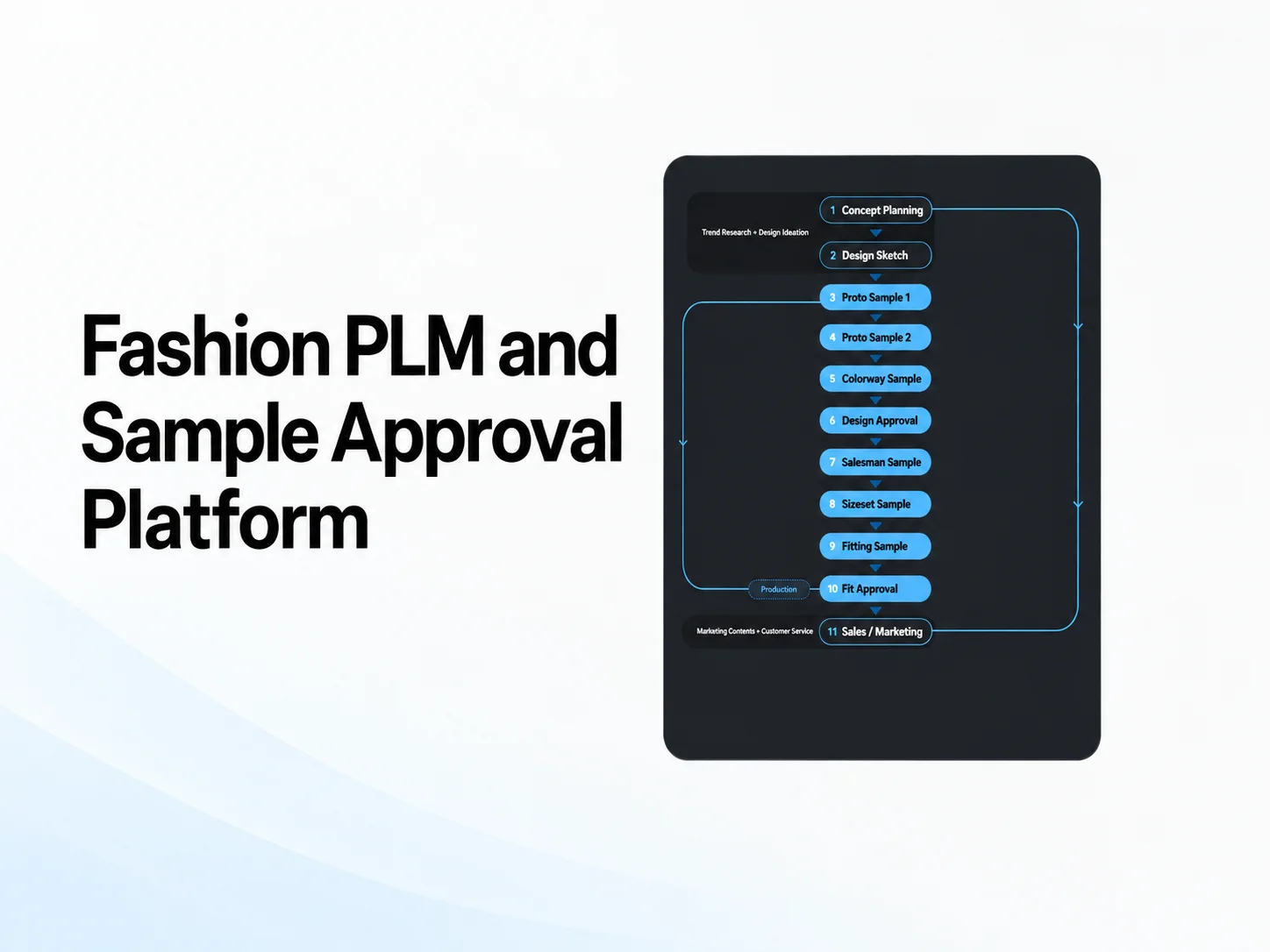
- Limited milestone visibility: Sourcing and merchandising teams may need to gather updates manually to see whether styles are at First Proto, Salesman Sample (SMS), Pre-Production Sample (PPS), or Top of Production (TOP).
Connected product-development tools can centralize records and organize review. Compare how each system handles versions, responsibilities, and handoffs in the configuration you are evaluating.
Core evaluation criteria for fashion PLM and sample platforms
Compare systems across five functional areas:
- Tech Pack and BOM management: Review how the platform organizes components, POMs, construction details, and changes to product data.
- Visual sample review and annotation: Check how reviewers examine physical-sample photos or virtual garments, record specific feedback, and follow revisions through sample review and approval workflows.
- Collection status and milestone management: Assess how teams view line plans, sampling cycles, critical-path dates, and collection progress.
- Partner access controls: Confirm how the platform scopes access for suppliers, mills, and other external collaborators.
- 3D asset and product-information connectivity: Check which 3D files, product records, viewers, and Tech Pack information are connected, and what integrations are needed.
Comparing the 8 leading fashion PLM and sample approval platforms
Note: The platforms below are presented for comparison, not as a ranked list. The right fit depends on each team’s workflow, product-development scope, integrations, and collaboration needs.
1. CLO-SET
CLO-SET connects Style and Colorway context, garment Versions, 3D assets, browser-based review, digital assets, Comments and Annotations, Workflow and Status, and Tech Pack information in a shared fashion product-development environment.
Content Page and product information
The New Content Page brings product information and review surfaces into the same Content workflow. Teams can use Overview, Viewer, BOM, POM, Cost Estimation, Attachment, and Content Analysis. BOM, POM, and Cost Estimation can be reviewed directly alongside the Content workflow, while the Viewer and related product context support garment review.
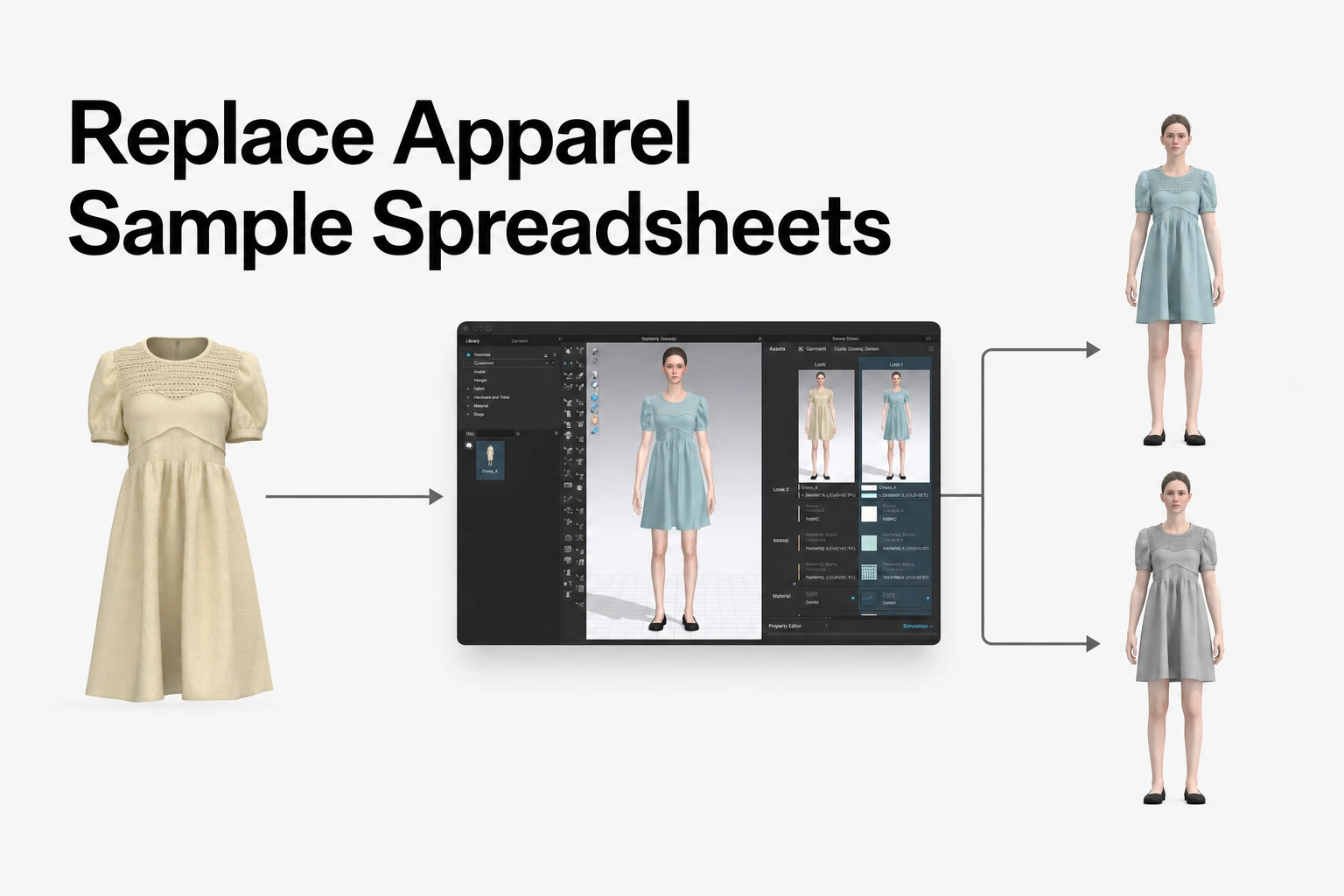
The Viewer supports 3D garment inspection, 2D Pattern Viewer access to pattern pieces, image viewing, and Render viewing. Reviewers can rotate and zoom garments in the browser, use Strain Map to examine distortion between 2D and 3D patterns, and create viewpoint-based Annotations. Comments support team discussion and an AI Translator for reading comments in a preferred language. Version context is available during product review.
Teams running a 3D virtual sample approval workflow can use CLO-SET’s browser-based 3D sample review, Annotations, Comments, Workflow, Status, and Version context to coordinate review and decision-making.
Tech Pack and BOM handoff
CLO-SET’s Web Tech Pack connects production information with 3D Content. When a new Style Version is uploaded and the user chooses UPDATE, supported Web Tech Pack information is updated for the new Version. New Content Page users can review BOM, POM, and Cost Estimation information directly. Supported Tech Pack information can be exported in Excel or PDF formats, and POM CSV can be used for measurement-data handoffs. Check the intended Version and product information before sharing downstream.
Workflow, Status, and collection review
In CLO-SET, Workflow is set at the Content level and Status is set at the Colorway level. Company Admins and above can configure Workflow and Status names. Admins, Collaborators, and Editors can update the values according to their permissions. Teams can use these fields to organize product-development progress and review collection status.
External partner sharing
CLO-SET organizes product assets through Group → Company → Brand → Line (optional) → Season → Workroom / Assortment → Content. Teams can share selected Workrooms, Assortments, or Content with external reviewers or partners using Editor or Viewer access. Viewer upload and download options can depend on the sharing configuration. For link-shared content, viewers can access the shared content, while downloads are limited to Group Members. Set access for the specific collaboration need and confirm the sharing configuration before inviting partners.
CLO-SET 2.0 (November 2026 release)
CLO-SET 2.0 (November 2026 release) expands the product-development scope from planning through production, giving teams a more connected way to collaborate with suppliers across material development, sample requests, order requests, product information, reviews, and handoffs between internal teams and external partners. Page Editor adds flexible planning and product-information views that teams can configure around their own processes.
Evaluation context: For teams evaluating fashion product-development or PLM workflows, CLO-SET is particularly relevant when 3D product development, browser-based review, Tech Pack information, digital assets, and supplier collaboration are central requirements. Broader PLM platforms become more relevant when the scope extends to formal lifecycle governance, complex change and release processes, or enterprise-wide workflows across additional business functions and systems.
Relevant to evaluate for: Apparel brands and manufacturers using 3D garment workflows that want browser-based 3D review, Version context, product information, Tech Pack collaboration, and external-partner coordination in one fashion product-development environment.
2. Centric PLM
Centric Software’s fashion solutions address product and collection work across planning, design, development, sourcing, pricing, inventory, and commercialization. Centric also describes a shared product-information environment and visual collaboration boards for design, assortment, development, and sourcing teams.
Product data and collaboration
Evaluate Centric PLM for the product records, Tech Pack, sourcing, and supplier workflows in scope. Centric’s broader fashion offering includes related solutions for planning and visual boards. Confirm which modules, permissions, and integrations cover each requirement in your implementation.
Sample review and line planning
Centric describes real-time team collaboration, visual assortment planning, and product lifecycle workflows. Test the sample, costing, assortment, supplier, and milestone views your team needs rather than inferring that every capability is included in the same configuration.
Relevant to evaluate for: Fashion brands, retailers, wholesalers, and manufacturers assessing connected product-lifecycle workflows across planning, product development, sourcing, and related business functions.
3. WFX PLM
WFX PLM covers fashion product data and development workflows, while its sample-management feature describes sample requests, status tracking, vendor feedback, and sample approval workflows.
Tech Pack and product data
WFX documents digital Tech Packs with components such as fabrics, care labels, buttons, zippers, and packaging materials. Its fashion PLM materials also describe product information, BOMs, measurements, and vendor collaboration. Confirm version behavior, grading requirements, and any care-label language needs with the vendor.
Sample tracking and vendor collaboration
WFX sample feedback can include comments, images, call-out annotations, and revised measurements. The platform describes automated notifications and sample status timelines. The WFX Click mobile app supports photo uploads for received samples, and WFX lists analytics for approval hit rates, sample lead times, and vendor scorecards. WFX states that a typical rollout takes 8–12 weeks, depending on workflow, integrations, and data requirements.
Relevant to evaluate for: Apparel brands, manufacturers, and buying organizations managing sample requests and feedback across distributed suppliers.
4. Lectra Kubix Link
Lectra Kubix Link is a cloud-based fashion PLM with related PIM, Board, and Forms capabilities. Lectra describes collection planning, product-data management, collaboration with suppliers, and configurable workflows.
Product data and collection management
Kubix Link supports detailed calendar views and dashboards for collection monitoring, cost tracking, milestones, durations, and roles. Its product page describes the creation and sharing of digital Tech Packs and product information in multiple formats. Confirm the modules and integrations needed for BOM synchronization, product data exchange, and any traceability requirements.
Review workflows and supplier collaboration
Lectra describes digital fitting sessions and collection reviews for internal and external stakeholders, with feedback and supplier communication. Evaluate the exact review experience, data scope, and external permissions in a pilot using representative styles.
Relevant to evaluate for: Fashion brands seeking collection calendars, product-data workflows, supplier collaboration, and related PLM/PIM capabilities in the Lectra environment.
5. Backbone PLM
Backbone PLM remains supported for existing customers. Bamboo Rose directs organizations evaluating a new platform toward its flagship TotalPLM offering.
Product-development records and Tech Packs
Backbone’s current product page describes customizable Tech Pack templates, live-link sharing with external collaborators, and libraries for BOMs, size specifications, and POMs. It also describes an Adobe Illustrator extension that lets designers upload designs and track version history, plus dynamic product fields that can appear in reports.
Evaluation context
Existing Backbone customers can confirm how Tech Pack templates, product fields, and reports work in their current configuration. New buyers should evaluate Bamboo Rose TotalPLM and verify the required product-development, supplier, and lifecycle capabilities in a demonstration.
Relevant to evaluate for: Existing Backbone customers maintaining established workflows. New platform evaluations should include Bamboo Rose TotalPLM.
6. Uphance
Uphance Apparel PLM connects product-development information with apparel operations. Its product materials describe Tech Packs, BOMs, size specifications, approvals, Version history, purchasing, inventory, and production records.
Product records and operations
Uphance says Tech Packs, BOMs, materials, and approvals can live on one product record with Version history. Its Adobe Illustrator integration supports two-way syncing of flats, artwork, colorways, and specifications. The product page also describes a critical-path time-and-action calendar that tracks milestones and dependencies and flags dates at risk.
Milestones and sample management
Uphance documents sampling, revisions, approvals, and stage-based progress. It positions broader enterprise PLM systems as deeper for multi-tier approval matrices and complex sample-round workflows, so teams with those requirements should validate fit during evaluation. Confirm how the selected configuration handles production, purchasing, inventory, and schedule updates after a product change.
Relevant to evaluate for: Apparel brands seeking connected product development and operational records, including purchasing, inventory, and production workflows.
7. Lifecycle PLM
Lifecycle PLM connects collection planning, product specifications, sample review, costing, tasks, supplier collaboration, and delivery workflows around product records.
Tech Packs and product development
Lifecycle Tech Pack Studio documents BOMs, measurements, annotations, revisions, and supplier collaboration. Its platform materials describe reusable materials, measurements, components, and templates, with sample, cost, timeline, and task information tied to product records.
Supplier collaboration and sample review
Lifecycle Sample Management describes tracking proto, fit, and pre-production rounds with measurements, annotated feedback, vendors, and approval status. Its supplier collaboration workspace lets teams share relevant product information, files, conversations, revisions, and decisions with suppliers. Validate access roles, integrations, and onboarding scope using real users and sample data.
Relevant to evaluate for: Teams seeking connected product specifications, sample rounds, supplier feedback, and collection schedules in one product-development workflow.
8. DeSL PLM
DeSL provides modular PLM software for fashion, retail, apparel, and footwear. Its product materials cover product development, supplier collaboration, planning, and related business processes.
Product and supplier workflows
DeSL’s PLM materials describe Tech Pack Management, sample workflows, and supplier collaboration capabilities. Evaluate the modules that support the team’s product data, supplier portal, sample submissions, and collection reporting requirements.
3D integration and virtual review
DeSL’s 3D Integration page describes viewing and interacting with 3D apparel models, annotating products, and connecting virtual samples with BOM, costing, and supplier data. Confirm supported formats, integrations, sample workflow, and the modules included in the proposed configuration.
Relevant to evaluate for: Apparel and footwear teams assessing modular product-lifecycle, supplier, planning, and 3D workflows.
Side-by-side platform comparison matrix
| Platform | Primary scope | Tech Pack / product data | Sample review | 3D asset and pattern support | Evaluation context |
|---|---|---|---|---|---|
| CLO-SET | Focused fashion product development | Content Page, BOM, POM, Cost Estimation, supported Tech Pack exports | Browser-based 3D and 2D pattern review, Annotations, Comments, Workflow and Status | CLO garment review, Strain Map, Render, and pattern inspection | Teams connecting 3D product development, product information, review, Tech Packs, and partner collaboration |
| Centric PLM | Product lifecycle and related fashion workflows | Product data and Tech Pack workflows, with scope to confirm | Sample, supplier, and visual collaboration workflows to evaluate | 3D integrations to confirm for the selected configuration | Teams assessing planning, development, sourcing, and enterprise-wide workflows |
| WFX PLM | Fashion PLM | Digital Tech Packs, BOMs, and measurement information | Sample requests, status tracking, vendor feedback, and mobile photo upload | Confirm the required file formats, viewer, and integrations | Teams coordinating product development and supplier sample workflows |
| Lectra Kubix Link | Fashion PLM with related PIM, Board, and Forms capabilities | Centralized product data and digital Tech Packs | Collection calendars, milestones, digital fitting, and collection reviews | Confirm the needed garment formats and connected tools | Teams coordinating collection management, product data, and supplier review |
| Backbone PLM | Supported product-development platform for existing customers | Tech Pack templates, product libraries, and live links | Confirm sample review requirements in the current setup | Illustrator design upload and Version history | Existing customers. New evaluations should include TotalPLM |
| Uphance | Apparel PLM connected to operations | Product records, Tech Packs, BOMs, and size specifications | Stage-based development, sampling, revisions, and approvals | Bidirectional Adobe Illustrator sync | Brands assessing product development connected to purchasing, inventory, and production |
| Lifecycle PLM | Connected apparel product development | Tech Packs, BOMs, measurements, annotations, and revisions | Sample rounds, annotated feedback, vendors, and approval status | Product files and 3D viewing requirements to confirm | Teams linking product development, supplier work, and sample decisions |
| DeSL PLM | Fashion PLM and supply-chain workflows | Modular PLM and Tech Pack capabilities | Confirm the required sample and supplier modules | Vendor-described virtual samples and 3D integration | Teams assessing product development, supplier collaboration, planning, and 3D workflows |
Decision framework: choosing a platform architecture
The right evaluation path depends on product-development scope, supplier complexity, 3D workflows, and the systems already used across the business.
Scenario A: Enterprise-wide PLM workflows
When to evaluate: Your organization coordinates multiple brands, global suppliers, complex product data, and integrations with existing enterprise systems.
- Platforms to assess: Centric PLM, Lectra Kubix Link, and DeSL PLM.
- Evaluation focus: Scope governance, product-data migration, integrations, supplier roles, training, and the business functions included in each proposal.
Scenario B: Product development connected to apparel operations
When to evaluate: Your brand or manufacturer needs structured Tech Packs and sample milestones connected to sourcing, purchasing, inventory, or production work.
- Platforms to assess: WFX PLM, Uphance, and Lifecycle PLM. Existing Backbone customers can assess their current setup, while new Bamboo Rose evaluations should include TotalPLM.
- Evaluation focus: Confirm workflow coverage, integrations, data migration, implementation timing, and required BOM or compliance processes. Cloud delivery alone does not establish deployment speed or feature depth.
Scenario C: Focused fashion product development and 3D collaboration
When to evaluate: Teams need Style and Colorway context, garment Versions, 3D visualization and review, 2D pattern inspection, Comments and Annotations, digital assets, Workflow and Status, Tech Pack information, and supplier or external-partner collaboration.
- Platform to assess: CLO-SET.
- Evaluation focus: Test browser-based 3D review, Content Page product information, Tech Pack handoffs, Workflow and Status, and partner access using representative products. CLO-SET can operate as the focused fashion product-development environment for these workflows and can also sit alongside broader enterprise systems when organizations require wider lifecycle governance.
How can brands and vendors reduce scattered file links during 3D sample review?
CLO-SET centralizes garment Content in a browser-based environment where reviewers can rotate and zoom the 3D garment, inspect 2D pattern pieces, use Strain Map, add Annotations and Comments, and work with Versions and product information in context. Set access for each reviewer, since file downloads depend on sharing configuration.
What is the difference between a full PLM and a focused fashion product-development workspace?
CLO-SET focuses on apparel-specific product-development workflows, including Style and Colorway context, 3D assets, browser-based review, Versions, digital assets, Workflow and Status, and Tech Pack information. For teams evaluating PLM-related workflows, it can be especially relevant when these product-development and collaboration needs are the immediate priority. Broader PLM systems typically extend further into formal lifecycle governance, complex change and release processes, and enterprise-wide workflows across additional functions and systems.
How does CLO-SET support external partner permissions?
Teams can share selected Workrooms, Assortments, or Content with Editor or Viewer access. Viewer upload and download options can depend on the sharing configuration. For link-shared content, viewers can access the shared content, while downloads are limited to Group Members. Confirm the intended access before sharing with external partners.
Can product-development platforms replace spreadsheets for collection status tracking?
Not always. Workflow, Status, product information, collection views, and connected product-development records can replace parts of a spreadsheet workflow. If the spreadsheet also manages broader schedules, supplier follow-up, costing, or custom reporting, confirm those requirements before retiring it.
How can digital Tech Packs help teams manage Version changes?
Digital Tech Packs can connect specifications to product records, but teams should verify how revisions and handoffs work in the selected system. CLO-SET’s New Content Page allows teams to review BOM, POM, Cost Estimation, garment review, and related product context in the same Content workflow. When a new Style Version is uploaded and UPDATE is selected, supported Web Tech Pack data can be updated for that Version. Supported Tech Pack data can be exported in Excel or PDF formats, and POM CSV is available for measurement-data handoffs. Confirm the intended Version and information before downstream sharing.
Connect 3D sample review and Tech Pack workflows
Bring browser-based garment review, pattern inspection, product information, and collaboration into a shared fashion product-development environment.
Source note
Product and platform descriptions in this comparison are based on publicly available official product pages, Help Center documentation, and vendor materials reviewed in October 2026. “Best” and “leading” are editorial search-oriented framing rather than a universal product ranking. Platform fit depends on workflow scope, modules, integrations, configuration, and collaboration requirements. CLO-SET 2.0 references use the November 2026 release scope and should be updated against final public release documentation when available.
- CLO-SET product development, Content Page, Workflow, permissions, and Tech Pack: official CLO-SET Help Center and product documentation, including Terms & Interface, Workflow & Status, Content Page Renewal, Web Tech Pack, Web Tech Pack BOM, Permission, and Share Space. Additional product-review sources include the Help Center guides for Strain Map, Comments, Annotations, and POM CSV exports, plus CLO-SET Tech Pack export updates.
- Centric Software: official Centric PLM fashion materials, sample and order workflows, sourcing and supplier materials, and 3D product-development materials.
- WFX: official WFX PLM, Tech Pack and product-development materials, and Sample Management documentation.
- Lectra Kubix Link: official Kubix Link PLM/PIM and product-development documentation.
- Bamboo Rose / Backbone: official Backbone product documentation and platform information.
- Uphance: official Uphance Apparel PLM documentation.
- Lifecycle PLM: official Lifecycle PLM, Fashion Sample Management, and Supplier Collaboration pages.
- DeSL: official DeSL PLM, Supplier Relationship Management, and 3D Integration pages.