3D Sample Review vs Physical Sample Rounds: Cost, Lead Time, and When You Still Need the Real Thing
The pitch for 3D sampling usually overshoots. Somebody demos a garment rotating in a browser and the conclusion lands as “we can stop making samples,” which isn’t true and sets the project up to be judged against a promise it can’t keep. The defensible version of the argument is narrower: some of your sample rounds exist to answer questions that don’t require fabric. Those are the rounds 3D takes, and they’re where most of the iteration, and most of the waste, lives.
 The pitch for 3D sampling usually overshoots. Somebody demos a garment rotating in a browser and the conclusion lands as “we can stop making samples,” which isn’t true and sets the project up to be judged against a promise it can’t keep. The defensible version of the argument is narrower: some of your sample rounds exist to answer questions that don’t require fabric. Those are the rounds 3D takes, and they’re where most of the iteration, and most of the waste, lives.
TL;DR
3D and physical sample rounds answer different questions, and the economics favor replacing the early rounds, not the final ones.
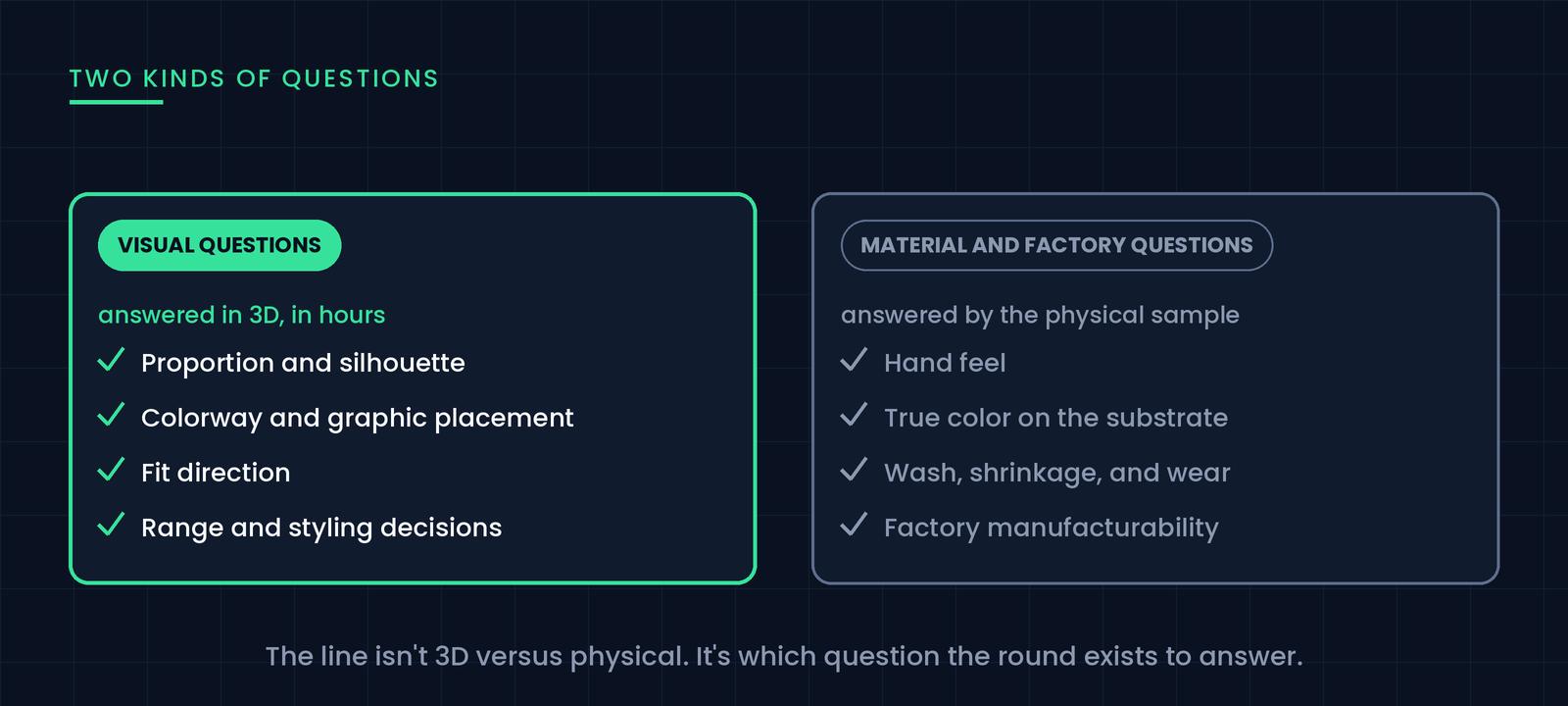
A 3D sample review evaluates a simulated garment in a browser, covering proportion, styling, colorway, graphic placement, and fit direction, in hours and at no per-round material or freight cost.
A physical sample round evaluates the made garment and is the only way to judge hand feel, drape in an unfamiliar fabric, true color on a real substrate, wash and wear performance, and factory manufacturability.
Most teams settle on a hybrid: review proto and fit questions in 3D, then keep a physical pre-production sample before releasing bulk. Push 3D into the PP round and the whole program loses credibility.
The constraint on 3D accuracy is fabric data, not garment software. On a measured material, simulated drape is reliable, and entering the real fabric type, composition, and weight gets a new material close enough for direction-level calls. The final drape judgment on a fabric you've never run still belongs to the physical sample.
Fund a digitized fabric library and validated blocks before buying more authoring seats, and give reviewers browser access instead of licenses. Baseline four metrics before you change anything: physical rounds per style, days per review round, sampling spend per style, and the share of styles reaching pre-production without an extra physical round.
APG & Co, the Australian group behind Saba, Sportscraft and Jag, reported a 50% reduction in development and fit sampling costs and an 80% time reduction on print strike-offs in FY25 on CLO and CLO-SET, in the eighth year of an adoption that began in 2019.
What Is a 3D Sample Review?
A 3D sample review is a review round run on a simulated garment instead of a sewn one. The team opens the 3D garment in a browser, checks proportion, colorway, graphic placement, and fit direction, and records comments and a decision against that version, in hours instead of weeks.
A physical sample round is the same decision process run on a made garment, and it answers a different class of question: how the fabric feels and falls, how color reads on the real substrate, and whether the factory can actually build the garment. Neither replaces the other outright.
The Comparison, Side by Side
Time to produce. A 3D review takes hours to a day, once blocks and materials are digitized. A physical round typically takes one to three weeks including make and freight.
Marginal cost per iteration. Effectively zero in 3D. Materials, labor, courier, and duties, every round, for physical.
How many iterations you can absorb. Many in 3D, because revising a colorway is a change, not a remake. Few physically, because each round consumes calendar.
Who can participate. Anyone with a browser link in 3D. Physically, whoever is holding the garment.
Simultaneous review across regions. Yes in 3D. Physically, no, unless you make duplicate samples.
Proportion and styling. Both answer this well.
Colorway and graphic placement. 3D answers this well. Physical answers it definitively.
Fit direction. 3D answers this well on digitized fabrics with validated blocks. Physical answers it definitively.
Hand feel. 3D cannot answer this. Physical can.
Drape in an unfamiliar fabric. 3D answers this reliably on a measured fabric, and approximately from the entered composition and weight. Physical answers it definitively.
True color on the substrate. 3D cannot answer this, because screen color is not a color standard. Physical can.
Wash, shrinkage, and wear performance. 3D cannot answer this. Physical can.
Factory manufacturability. 3D cannot answer this. Physical can.
An audit record of the review. 3D leaves one natively. A physical round leaves one only if somebody maintains it.
What a 3D Sample Review Answers Well
Proportion and silhouette. Hem length, sleeve break, pocket scale, collar size, the relationship between panels. These are visual judgments, and a simulated garment on a correctly sized avatar answers them as well as a photograph of a real one.
Colorway and print placement. Applying six colorways to a garment in 3D takes minutes. Making six is a sample round. This is the single biggest source of physical rounds that 3D removes outright, and it’s where APG & Co reported their largest gain: an 80% time reduction on print strike-offs, achieved by finalizing prints, colors, and placement digitally before anything was printed.
Graphic scale and position. Where a logo lands relative to a seam, how a placement print reads across a size range, whether a graphic collides with a pocket. Cheap to check, expensive to discover on a physical sample.
Fit direction. With a validated block and a properly digitized fabric, 3D will tell you whether an armhole is fighting the sleeve or whether a waist seam is sitting wrong. It won’t replace a fit session, but it moves the conversation forward by a round.
Review logistics. A link opens for everyone at once. No duplicate samples for the buying team, no courier to the overseas merchandiser, no waiting on the one person holding the garment. This is also what makes supplier participation practical at scale: APG & Co onboarded 10 supplier factories onto the platform by 2025, covering half the group’s woven factories, and initially covered their license fees to remove the cost barrier.
What Only a Physical Sample Can Answer
Hand feel. No simulation conveys it, and for a lot of product categories it’s a purchase driver.
Drape in a fabric you haven’t used before. Simulation quality tracks the fabric data behind it. A measured, previously validated material simulates reliably, and entering the real specs, meaning fabric type, composition, and weight, gets close enough for direction-level judgments, which is exactly what CLOFAB computes drape from. What stays physical is the final confirmation: that a fabric you’ve never run behaves on the garment the way its digital version says it does. (This is why fabric digitization quality is the constraint on 3D accuracy, not the garment software.)
True color. Screens are not color standards. Lab dips and strike-offs get approved physically, under controlled light, against a physical reference.
Wash, shrinkage, and wear performance. Requires a real garment and a real machine.
Manufacturability. Whether a specific factory can build this garment repeatably, at quality, in bulk materials, is a question about the factory. That’s the pre-production sample’s job and 3D doesn’t touch it. See pre-production sample review.
The Hybrid Model Most Teams Land On
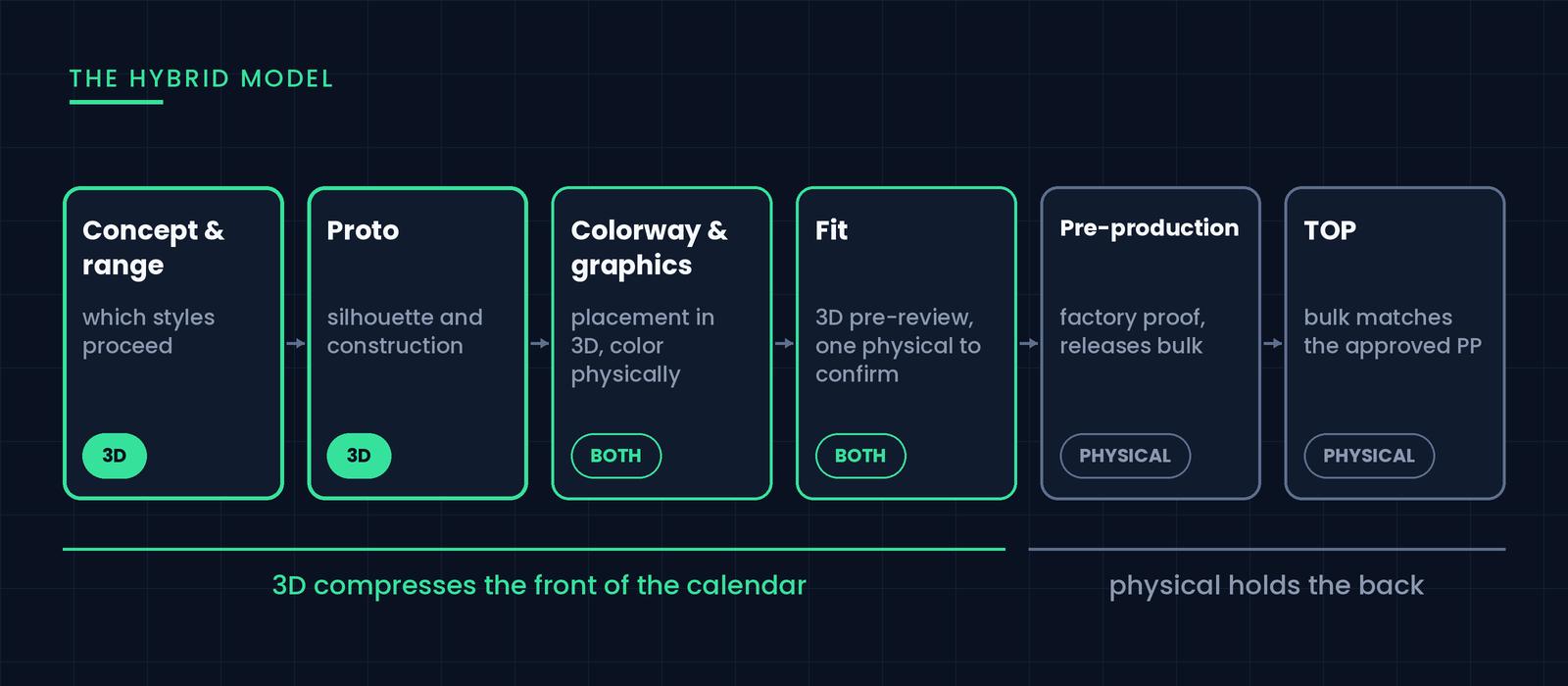
Concept and range review: 3D. Decides which styles proceed, and whether the range hangs together.
Proto: 3D, with a physical sample only for construction you haven't built before. Decides silhouette, proportion, and construction approach.
Colorway and graphic approval: both. 3D for placement and scale, a physical lab dip or strike-off for the color itself.
Fit: 3D pre-review, then one physical fit sample. 3D resolves fit direction and the physical sample confirms it.
Pre-production: physical, always. Decides factory manufacturability and releases bulk.
TOP or shipping: physical. Decides whether bulk output matches the approved PP sample.
The pattern: 3D compresses the front of the calendar, where iteration is cheap and questions are visual. Physical samples hold the back of the calendar, where the decisions are about materials and manufacturing. Teams that try to push 3D into the PP round usually end up discrediting the whole program.
What It Costs to Set Up
The per-round savings are real, and they’re preceded by fixed work that belongs in the business case.
Digitized fabric library. The largest and most valuable investment. Accuracy downstream depends on it, and it compounds, because a validated material gets reused across every style that follows.
Validated blocks and avatars. 3D fit judgment is only trustworthy against blocks that have been checked against real garments.
Asset organization. A 3D program generates files quickly, and unmanaged files stall reviews as effectively as slow sampling does. Worth solving before scaling: how to manage and share 3D garment files.
Reviewer access, not reviewer licenses. The common budgeting mistake is pricing a 3D seat for everyone who needs to look at a garment. Reviewers need to view and comment, which a browser-based viewer covers. Only the people building garments need authoring software.
Time for the workflow to settle. APG & Co’s figures come from an adoption that started in 2019, not from a quarter. Their own sequencing is worth borrowing: Saba reached 100% of development styles on CLO in 2022, Sportscraft and Jag followed in 2023, and the ten supplier factories were onboarded by 2025. The early gains are logistical, meaning faster reviews and faster strike-offs. The larger cost reductions arrived once supply-chain adoption crossed critical mass.
How to Tell Whether It’s Working
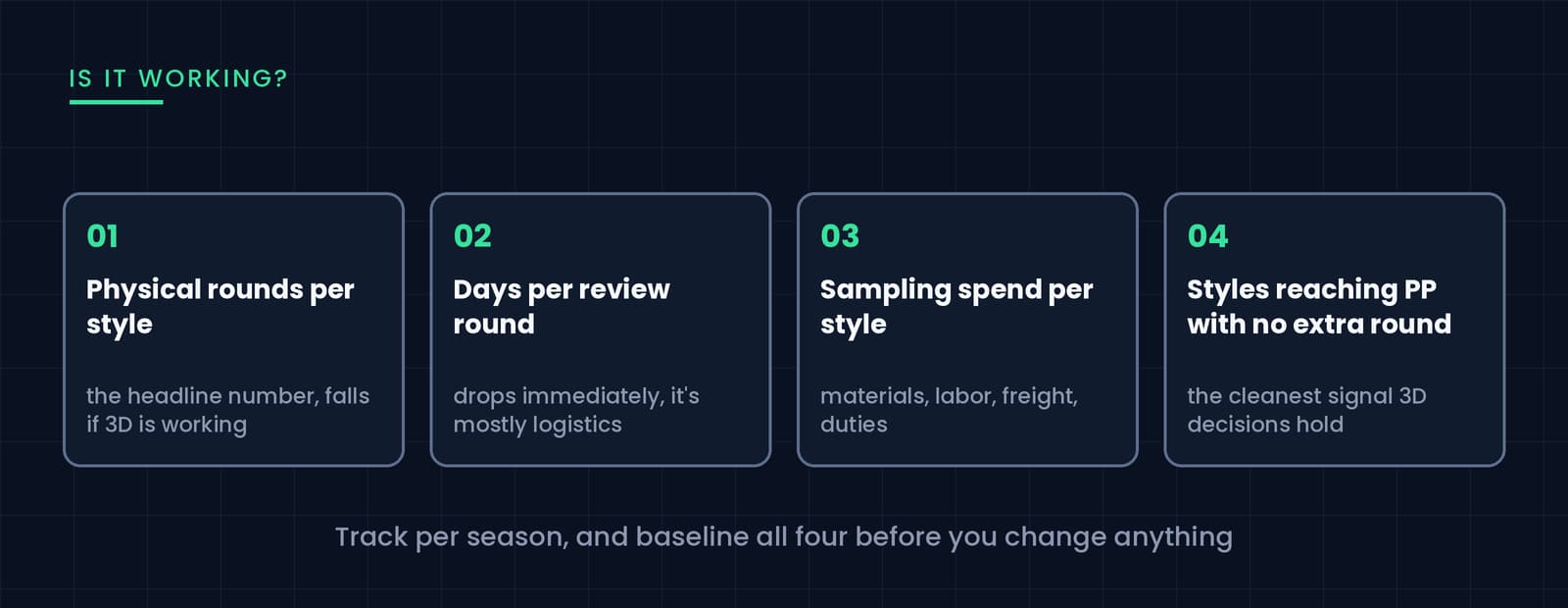
Four metrics, tracked per season rather than per style:
1. Physical rounds per style. The headline number. If 3D is working, this falls.
2. Days per review round. Should drop immediately, since it’s mostly logistics.
3. Sampling spend per style. Materials, labor, freight, duties. The number a CFO will ask for.
4. Share of styles reaching PP without an extra physical round. The cleanest signal that 3D decisions are holding up.
Baseline all four before you change anything. A 3D program without a pre-change baseline is very hard to defend at budget time, which is the most common reason good programs get cut.
How CLO-SET Handles This
CLO-SET is the workspace where the hybrid model runs. 3D garments, sample photography, digitized fabrics, and the tech pack live on the same Style inside shared Rooms.
Every 3D file gets a browser-based 3D Viewer, so merchandisers, buyers, and factories review garments without a CLO license. That is the reason 3D review gets cheap enough to use on every round, not only on hero styles. Rounds arrive as new versions of the same Style, pushed in from CLO with Direct Upload. Feedback splits into Annotation for notes pinned to a point on the garment and Comment for threaded discussion. Decisions are recorded by changing the style’s Workflow Status, with a separate Status on each colorway, and both sets of names are defined per company. Assortment gives the range-level view for deciding on multiple Styles at once. Access is set with Permission at Space, Room, or Style level. Fabrics can be digitized in-house with CLOFAB, and the materials side is where CLO Virtual Fashion is investing hardest: the company acquired swatchbook, the digital materials platform, in 2025, folding it into its materials division. Since fabric data is the constraint on 3D accuracy, that is exactly where the investment belongs. And because garment data is structured, Measurement and Bill of Materials feed the specification from the same Style the review ran on.
APG & Co’s FY25 results, reported by the Australian trade publication Ragtrader, are the clearest picture of what the hybrid model delivers at group scale:
Development and fit sampling costs: down 50%.
Print strike-off time: down 80%.
Styles developed and managed on CLO and CLO-SET: 100%, across Saba, Sportscraft and Jag.
Supplier factories onboarded: 10, covering half the group’s woven factories.
First CLO adoption: 2019, as the first Australian fashion retailer to do so.
Read those figures as a result of CLO and CLO-SET together. Designing in 3D removes the guesswork from the garment. It does not remove the email thread, the couriered strike-off, or the question of which version the factory is holding. Those go away when review, versioning, and approval run in a shared workspace as well, which is where the supply-chain-wide part of the saving comes from.
The figures were also assessed externally: the group was named a Best Use of Technology finalist at the 2026 AFIA on the strength of that work.
Read the full story, or the underlying report in Ragtrader.
FAQ
Can 3D sampling replace physical samples entirely?
No, and programs sold on that premise tend to fail. 3D replaces the rounds that answer visual questions: proportion, colorway, graphic placement, fit direction. Hand feel, true color, wash performance, and factory manufacturability need a physical garment. The realistic target is fewer physical rounds, with a pre-production sample retained before bulk. That said, teams with years of accumulated experience and a deeply digitized asset base do push further: on repeat styles running at validated factories in already-approved materials, some go all the way to bulk with no physical round at all. That is an end state earned through validation, not a starting point.
How much does 3D sampling actually save?
It depends on how many of your current rounds are visual-question rounds, which varies a lot by category. As a published reference point, APG & Co reported a 50% reduction in development and fit 스sampling costs and an 80% time reduction on print strike-offs in FY25, in the eighth year of an adoption that began in 2019. The most reliable way to forecast your own number is to count how many of last season’s rounds were resolved by looking rather than touching.
Is 3D fit accurate enough to approve a fit?
It’s accurate enough to make fit decisions when the block has been validated against real garments and the fabric data is real: measured with a fabric kit, or at minimum entered from the actual type, composition, and weight rather than guessed. Both conditions matter. On a fabric you’ve never run, most teams use 3D to resolve fit direction and keep one physical fit sample to confirm.
Do reviewers need 3D software licenses?
No, on a platform with a browser-based viewer. Reviewers rotate, zoom, and comment on the garment through a link, in any browser, without installing anything. Only the people authoring garments need 3D software, which is also why external factories and buyers can be included without seat cost.
What’s the first thing to invest in when starting 3D sampling?
Fabric digitization. Every downstream claim about 3D accuracy rests on material data, and it’s the asset that compounds across seasons. Validated blocks come second. Buying more authoring seats before either of those is the usual way a program stalls.
Should we still do a pre-production sample if the 3D review was approved?
Yes. A 3D review can’t evaluate whether a specific factory can build the garment repeatably in bulk materials, which is the only thing a PP sample exists to establish. Skipping it means the first bulk-materials, bulk-line garment you see is the production run.
続きを読む
すべて見るTop 5 3D Product Collaboration Tools for Fashion Brands (2026)
Ask a fashion team why they’re looking at 3D collaboration tools and the answer is rarely about 3D. It’s about the Tuesday a vendor built a sample from the version that got superseded on Monday, or th

Pre-Production Sample Review: What to Check, Who Signs Off, and When It Happens
By the time a pre-production sample arrives, the interesting decisions are over. The silhouette was settled at proto. The fit was settled two rounds ago. What’s left is the dullest and most expensive
Digital Sample Review and Approval: A Complete Workflow for Fashion Teams
A fit sample lands on the desk. Someone photographs it against a white wall, drops four images into an email, and writes "shoulder looks off." Three days later the vendor replies asking which shoulder