What 8 Years of 3D Adoption Actually Delivers: 50% Lower Sampling Costs and 80% Faster Strike-Offs
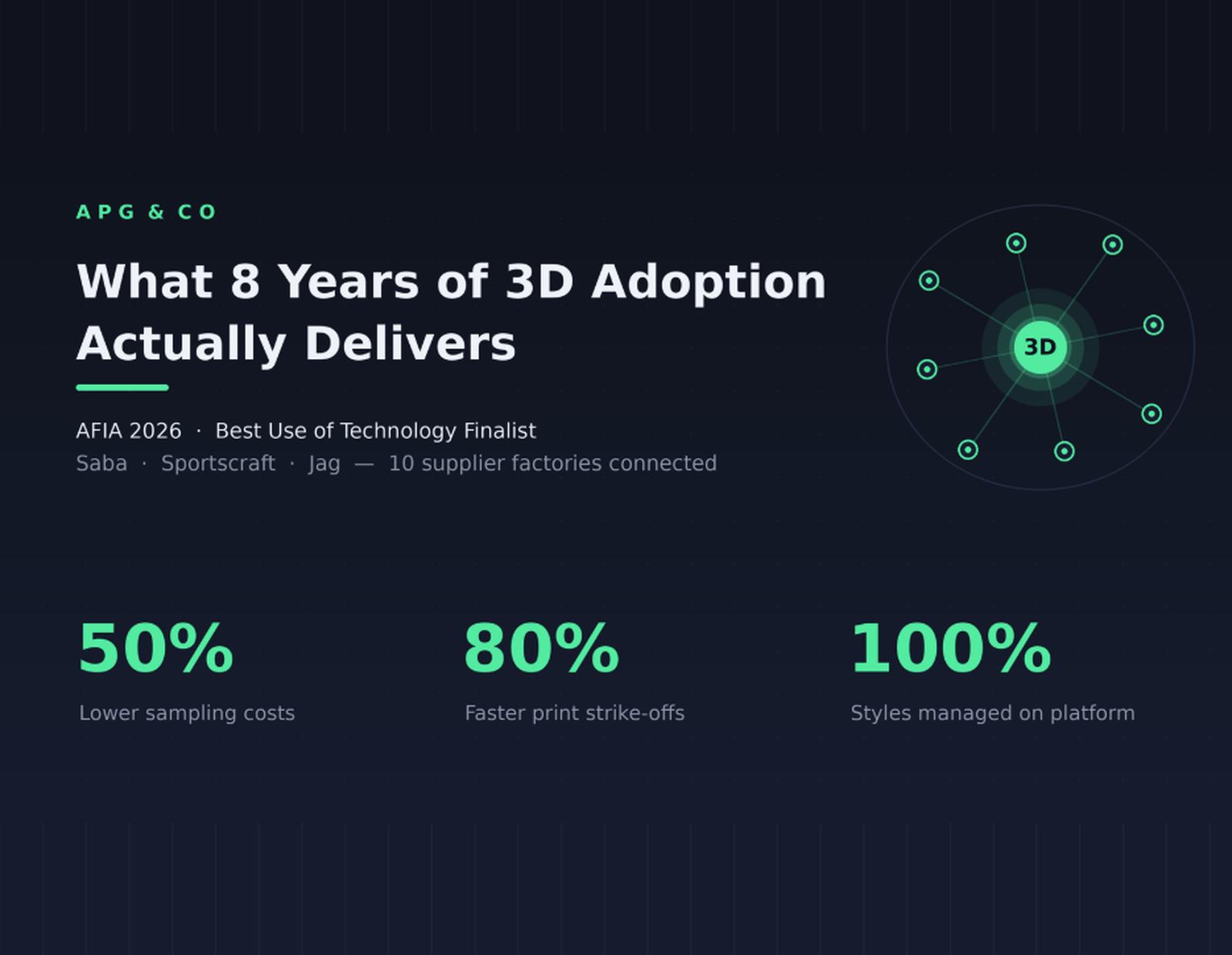
How much does 3D garment simulation actually save a fashion business? For Australian fashion group APG & Co — the company behind Saba, Sportscraft and Jag — the answer in FY25 was a 50% reduction in development and fit sampling costs and an 80% time reduction on print strike-offs, with 100% of styles across all three brands developed and managed on CLO and CLO-SET. Those results earned APG & Co a finalist spot for Best Use of Technology at the 2026 Australian Fashion Industry Awards.
The numbers are impressive. But the more useful story for any brand evaluating digital product creation is where those numbers came from — because they didn’t come from design software alone.
What results can a brand expect from 3D garment simulation?
APG & Co’s FY25 results, as reported by industry publication Ragtrader, break down like this:
APG & Co developed and managed 100% of styles across Saba, Sportscraft and Jag on the CLO and CLO-SET platform.
Print strike-offs became 80% faster because prints, colours and placement were finalised digitally before anything was printed.
Development and fit sampling costs fell by 50%, because physical samples became confirmations rather than experiments.
10 supplier factories were fully trained and onboarded on CLO and CLO-SET, covering half of the group’s woven factories.
One caveat that matters: these are eighth-year numbers. APG & Co adopted CLO in 2019 as the first Australian fashion retailer to do so. The savings compounded as adoption spread — first through design teams, then through the supply chain. Over this eight-year journey, APG’s GM of Supply Chain and Head of Global Quality have been valuable partners in pushing the boundaries of 3D adoption. Their passion for improving fit, quality, and sustainability as a standard for fashion companies and supplier factories provided invaluable industry feedback, helping shape how CLO-SET delivers impactful agility and efficiencies today.
Why the True Synergy Happens When 3D Design Meets a Collaborative Platform?
While 3D design software is a powerful tool on its own, its true potential is unlocked when it works in synergy with a connected collaboration platform. When 3D tools are used independently, digitally simulated garments are often exported as static tech packs and emailed to partners, bringing back the ambiguity that 3D was supposed to eliminate. Fit comments get scattered across email threads, and physical strike-offs are still couriered back and forth. The real breakthrough happens when 3D design is seamlessly integrated with a collaborative workspace.
This synergy creates mutual savings across the entire supply chain, extending far beyond any single company's success. Whether it’s the brand’s internal team creating the 3D assets or the vendor factories driving the 3D design, a shared workspace aligns everyone involved. When both brands and suppliers can open, review, and interact with the exact same 3D garment in real time, version confusion disappears.
Designing in 3D is an exceptional capability, but the most significant ROI—drastically reduced sampling costs and strike-off times—is mutually shared when reviewing, versioning, and approving happen natively in a shared 3D environment across the entire supply chain.
How do you onboard suppliers to a 3D workflow?
APG & Co’s supplier strategy had three moves worth borrowing:
Remove the cost barrier first. APG & Co initially covered its suppliers’ CLO-SET licence fees to accelerate adoption. Funding supplier licences looks like an expense; in practice it’s the cheapest way to eliminate thousands of hours of email-and-courier iteration.
Sequence by brand, not big-bang. Saba completed 100% of development styles on CLO in 2022. Sportscraft and Jag followed in 2023. Each rollout de-risked and informed the next, and by 2025 ten supplier factories were fully onboarded.
Make it the industry standard, not a secret. In 2026, APG & Co introduced the platform to industry body Seamless, which has since onboarded it as a supporter and promotes it to all members.
How long does it take to see ROI on digital product creation?
APG & Co’s timeline offers a realistic benchmark:
Year / Milestone
2019 First CLO adoption : the first Australian fashion retailer to do so
2020–21 : Remote collaborative design through COVID accelerated adoption
2022 : Saba reaches 100% of development styles on CLO
2023 : Sportscraft and Jag reach full development on CLO
2025 : 10 supplier factories fully onboarded on CLO and CLO-SET
FY25 : 50% sampling cost reduction; 80% faster strike-offs; 100% of styles managed on platform
The early wins (fewer samples, faster iteration) arrive within the first seasons. The transformational numbers arrived when supply-chain adoption crossed critical mass — a useful expectation-setter for any brand building a business case.
Third-party validation: AFIA 2026 finalist
Results self-reported by vendors are easy to discount. APG & Co’s outcomes were assessed by the Australian Fashion Industry Awards, which named the group a Best Use of Technology finalist for 2026, calling its journey an industry best-practice case study in digitising Australian fashion development. Winners are announced 6 August 2026 in Melbourne — congratulations to the entire APG & Co team, and we’ll be cheering. 🎉
Frequently asked questions
What is the ROI of 3D garment simulation?
Results vary by adoption depth. APG & Co reported a 50% reduction in development and fit sampling costs and an 80% time reduction on print strike-offs in FY25, after reaching 100% platform adoption across three brands and onboarding 10 supplier factories.
How long does it take to fully adopt 3D garment simulation?
The timeline varies significantly depending on a brand's scale, internal strategy, and supplier network. While initial wins—such as reduced physical sampling—often appear within the first few seasons, full supply-chain integration is typically a multi-year journey. As a real-world benchmark, APG & Co took roughly three years to bring its first brand (Saba) to 100% 3D development, and about six years to reach full adoption across its three brands and entire vendor network.
What’s the difference between CLO and CLO-SET?
CLO is the 3D garment simulation software where garments are designed and simulated. CLO-SET is the connected collaboration platform where those 3D assets are reviewed, versioned, approved and handed off across teams and suppliers — the layer where supply-chain-wide savings occur.
What is a digital strike-off?
A digital strike-off finalises prints, colours and placement on a simulated 3D garment before physical printing. APG & Co reported this cut strike-off time by 80% compared with physical rounds.
APG & Co adoption history and results cited from Ragtrader, “AFIA Finalists 2026: Best Use of Technology,” 23 July 2026.
続きを読む
すべて見るHow Murph Studio Made Client Reviews 40% Faster with Shareable 3D Product Reviews
CLO-SET helps studios turn client reviews from a back-and-forth of static images into a shared 3D experience. CLO-SET helps studios turn client reviews from a back-and-forth of static images into a
How Fadinha 3D Studio Reduced Review Cycles by 67% with Connected Product Development
CLO-SET helps teams keep assets, versions, and feedback connected throughout product development. In fashion product development, every style goes through multiple rounds of reviews, revisions, and ap
Top 5 3D Product Collaboration Tools for Fashion Brands (2026)
Ask a fashion team why they’re looking at 3D collaboration tools and the answer is rarely about 3D. It’s about the Tuesday a vendor built a sample from the version that got superseded on Monday, or th