How to Optimize Fashion Product Development with Practical 3D Workflow Tips - 2026 CLO-SET Webinar
Fashion product development involves much more than creating 3D garments. Teams collaborate across design, development, merchandising, and production, and the workflow connecting them determines how much time goes to manual work instead of decisions.
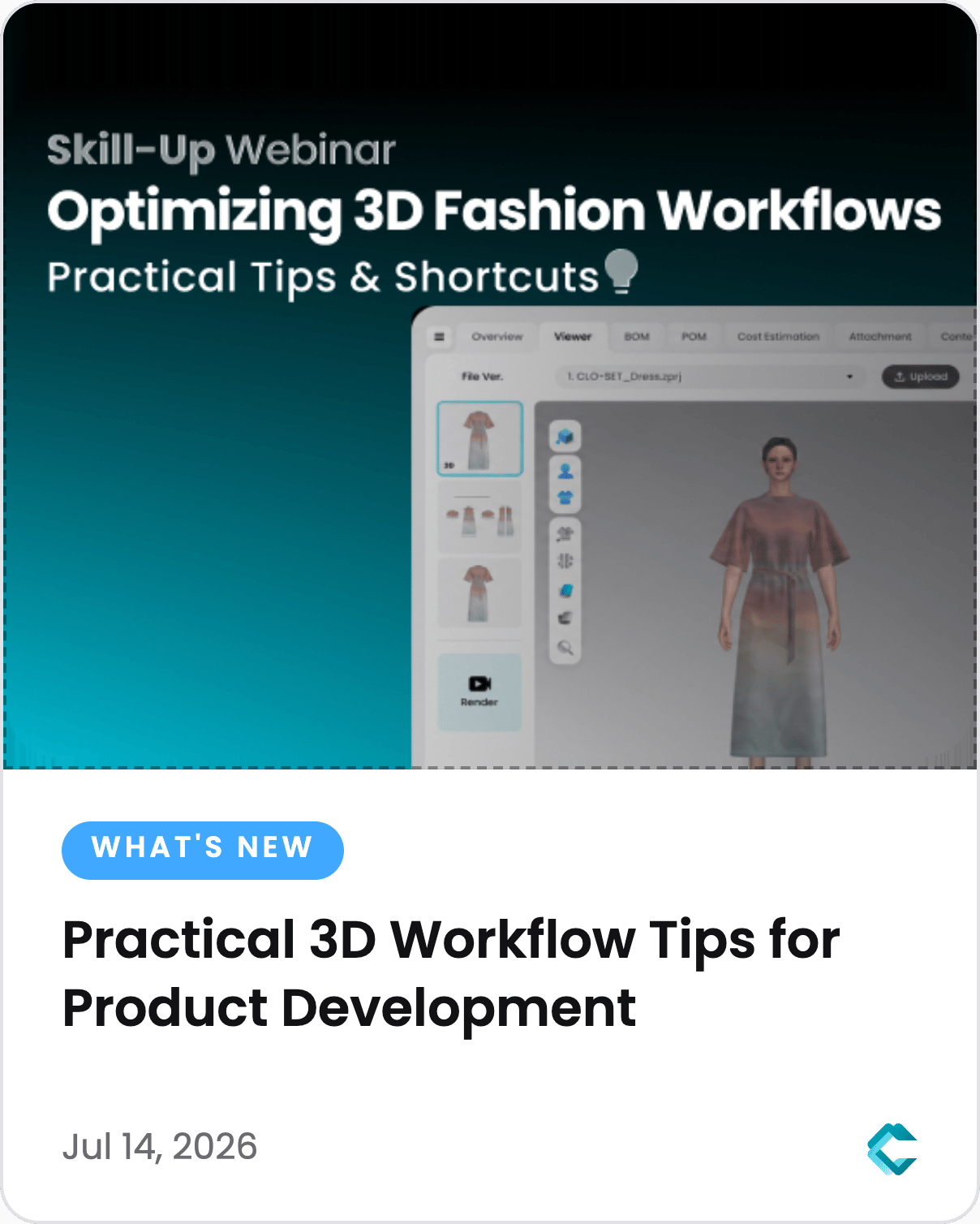
 Fashion product development involves much more than creating 3D garments. Teams collaborate across design, development, merchandising, and production, and the workflow connecting them determines how much time goes to manual work instead of decisions.
In our 10th CLO-SET Skill-up Webinar, we shared practical tips and productivity features for each stage of product development: organizing product information, creating samples, reviewing collections, and measuring development performance.
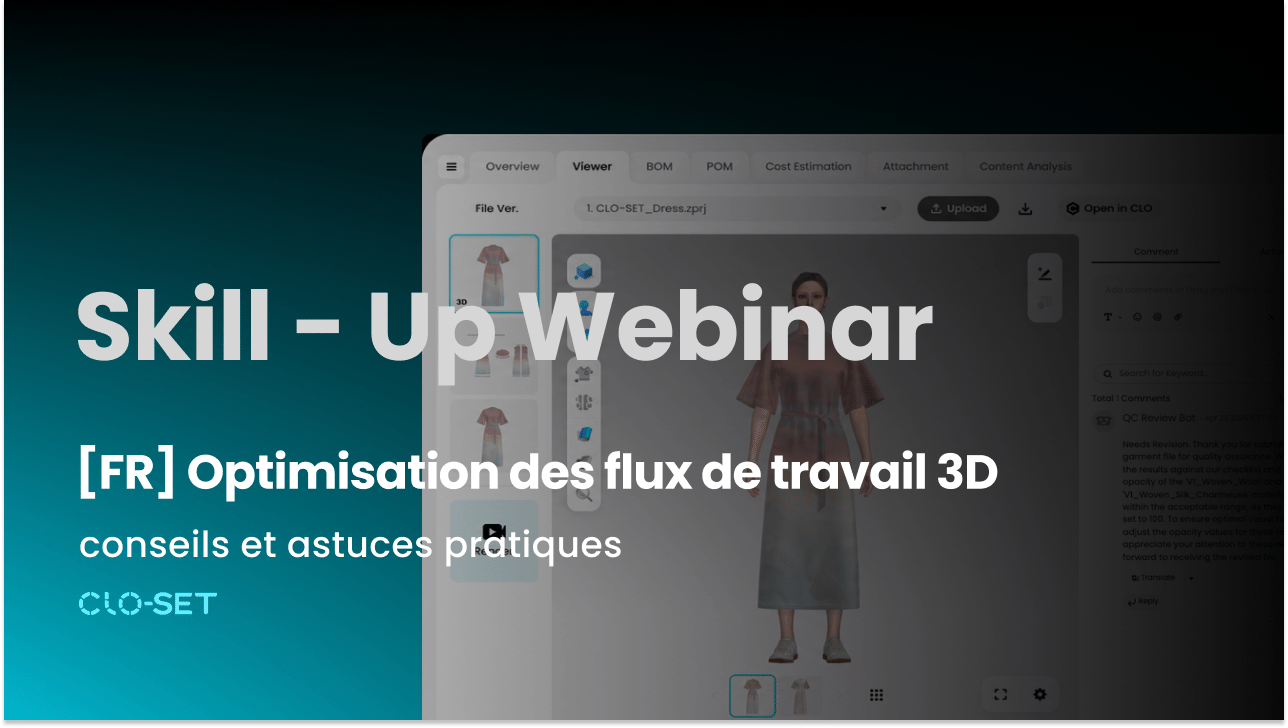
After the global session, we also held localized webinars for several regions so users could learn these workflows in their preferred language. All recordings are now available on the CLO-SET YouTube channel, where you can revisit any session and watch the full demonstrations.
Below are the workflow improvements covered in the series.
Key takeaways
Build a structured product foundation before design begins
Find and reuse assets more efficiently during sample creation
Speed up sample reviews with AI-powered collaboration tools
Standardize collection reviews and merchandising workflows
Measure product development performance with actionable analytics
1. Build better product foundations (product development)
Features covered
Enhanced Compatible Formats
Placeholder Creation
Overview Tab
BOM & POM Tab
Efficient product development starts with organized product information, not the first 3D garment. Before a design is finalized, teams collect inspiration, technical references, materials, and product specifications from multiple sources, and development goes smoother when all of it lives in one workspace.
CLO-SET supports this with broad file format compatibility, placeholder styles, and structured product data in the Overview, BOM, and POM tabs. Teams can set up product data early and keep it connected as the design evolves.
2. Speed up sample creation (sample creation)
Features covered
Universal Browser (CLO3D)
Workspace Browser
Tag & Category
Advanced Search
Efficient sample creation depends as much on finding the right assets as on designing quickly. Digital libraries keep growing, and digging through folders stops scaling. Tags, categories, filters, and image-based search let designers locate fabrics, graphics, and reusable styles without breaking their workflow, and direct access to shared libraries from both CLO and CLO-SET cuts extra steps during sample creation.
3. Make sample reviews faster (sample review)
Features covered
Quality Check Bot
Enhanced Viewer
AI Translation
Linked Content
Review cycles are often the biggest bottleneck in fashion product development. Instead of reviewing static images or checking every garment by hand, teams can inspect interactive 3D samples, verify construction details, and automate repetitive quality checks. AI translation makes collaboration easier for global teams, and Linked Content keeps related assets and product versions traceable.
Want to see these workflows in action? Watch the complete recordings on the CLO-SET YouTube channel for the full demonstration of each workflow in this article.
[EN Session]
[CN Session]
[FR Session]
[KR Session]
[ES Session]
Continue lendo
Ver tudoNew in CLO-SET: Meet CLOFAB, Your Built-In Fabric Digitization Tool
Accurate digital fabrics are the foundation of every reliable 3D garment — and building them should be simple for everyone in the supply chain, not just 3D specialists. Today we’re introducing CLOFAB
2026 Q2 Updates in CLO-SET: Better Product Reviews, Smarter Tech Packs
Q2 updates cover the full stretch between product reviews and production documentation: better vendor communication, more confident quality reviews, and more complete tech packs. Explore what's new in
2026 Q1 Updates in CLO-SET: Streamlining Product Development Workflows
Q1 updates support fashion teams at both ends of product development: shaping concepts earlier and preparing production documentation with less manual work. Explore what's new in CLO-SET . [Moodboar