Pre-Production Sample Review: What to Check, Who Signs Off, and When It Happens
By the time a pre-production sample arrives, the interesting decisions are over. The silhouette was settled at proto. The fit was settled two rounds ago. What’s left is the dullest and most expensive question in the whole calendar: can this factory, on this line, with these materials, make this garment correctly, over and over? Approve it and bulk fabric gets cut. Approve it carelessly and you find out at TOP, when there is no round left to fix anything.
 By the time a pre-production sample arrives, the interesting decisions are over. The silhouette was settled at proto. The fit was settled two rounds ago. What’s left is the dullest and most expensive question in the whole calendar: can this factory, on this line, with these materials, make this garment correctly, over and over? Approve it and bulk fabric gets cut. Approve it carelessly and you find out at TOP, when there is no round left to fix anything.
TL;DR
A pre-production sample, usually shortened to PP sample, is the last sample made before bulk production, and the PP review is the round that decides whether bulk fabric gets cut.
It must be sewn by the factory that will produce the order, on their equipment, in the approved bulk fabric and trims. A well-made sample from any other facility answers a different question.
Design and fit are locked by this point, so the round is not a design review. It answers one question: is this garment correctly and repeatably manufacturable here, to spec?
The review checks five things: construction against the tech pack, measurements against the graded spec at tolerance, approved materials, labeling and compliance, and workmanship. Measure before you judge how the garment looks, and record actuals rather than pass or fail.
Sign-off splits by function: the technical designer owns conformance to spec, QA owns quality acceptance, and production and sourcing own the release of bulk materials. The designer flags appearance deviations without re-opening design, and the factory never approves its own sample.
It closes with a written decision of approve, approve with conditions, or reject, recorded against a specific sample with one named owner. Distributed approval is how bulk gets cut on a garment nobody actually cleared.
Most of a PP review runs remotely. Conformance to the tech pack, measurement verification, labeling, workmanship inspection, and the decision record all work digitally. Drape and on-body behavior simulate reliably once the fabric's physical properties are measured. Hand feel, true color against a physical standard, and wash performance still need the physical garment.
Four of the five most common rejection causes are upstream review failures rather than factory failures, which is the argument for closing every earlier round with a recorded decision. Teams that run every round this way have numbers to show for it: APG & Co reported a 50% reduction in development and fit sampling costs in FY25, running 100% of styles across three brands on CLO and CLO-SET.
What is a Pre-Production Sample?
A pre-production sample is the garment the production factory sews on its own line, in the approved bulk fabric and trims, to prove it can manufacture the style to specification before bulk cutting is released.
That definition carries three requirements, and the review tests all of them. The right factory: the facility that will actually run the order, not a development sample room. The right materials: approved bulk fabric, lab dips, strike-offs, and trims. The right document: the current tech pack, with every correction from the earlier rounds written in. Remove any one of the three and the sample stops answering the question this round exists to ask.
Where the PP Sample Sits in the Sequence
Proto, or first sample. Made by a sample room or development vendor, to confirm the concept, silhouette, and construction approach. Approving it means the style keeps developing.
Fit sample. Made by a sample room or vendor, to confirm base-size fit, balance, and measurements. Approving it locks the fit and the grade.
Pre-production sample, or PP sample. Made by the production factory, to confirm that factory can build to spec in bulk materials. Approving it releases bulk cutting.
TOP, or shipping sample. Made by the production line, to confirm bulk output matches the approved PP sample. Approving it releases the shipment.
The distinction that matters most: a fit sample can come from anywhere, including a sample room on the other side of the world from where the order will be made. A PP sample has to come from the actual production factory. That’s the entire point of the round. A beautifully executed sample from the wrong facility tells you nothing about the order you’re placing.
What a Pre-Production Sample Review Actually Checks
The check breaks into five blocks, and reviewing them in this order stops the round from drifting into design commentary.
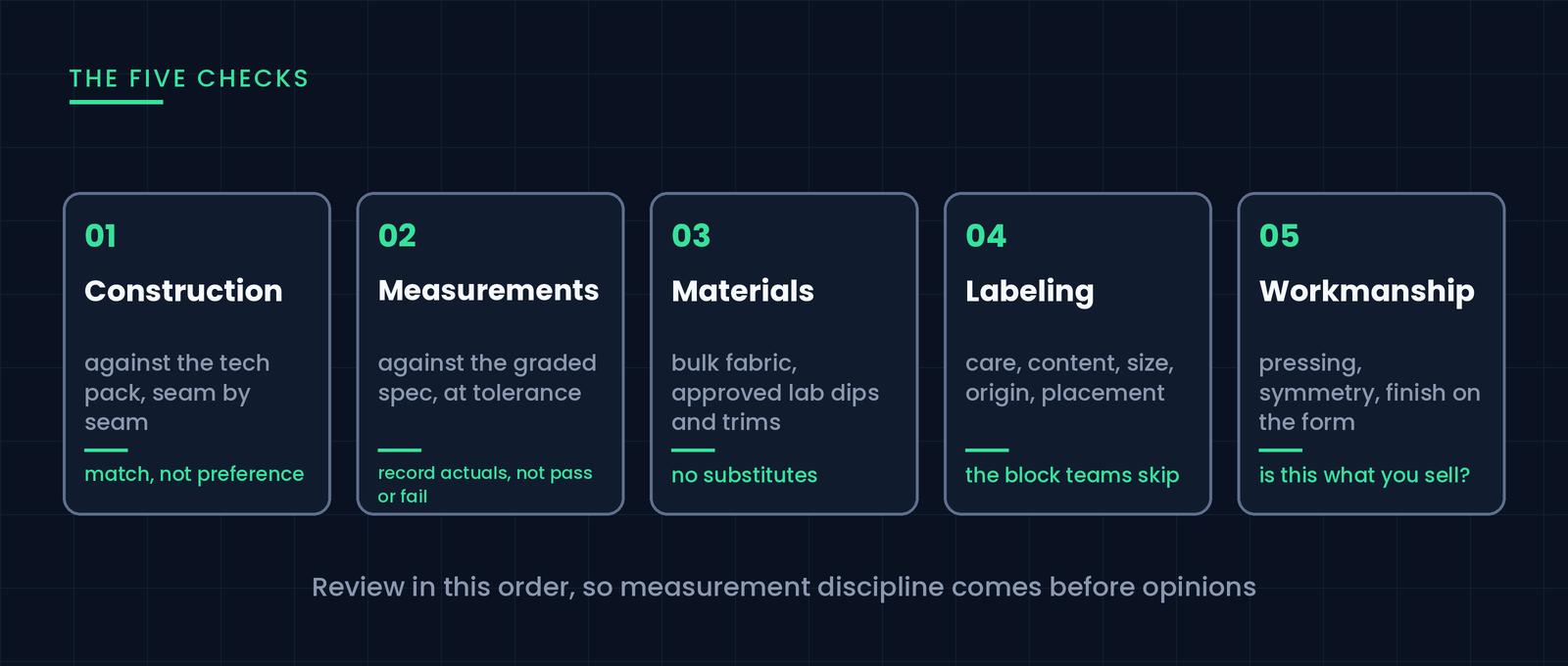
Construction against the tech pack. Seam types, stitch density, topstitch placement and margin, seam finishes, interlining and fusing, pocket and closure construction, bar tacks and reinforcement points. The question is conformance, not preference: does it match the specification the factory was given?
Measurements against the graded spec. Measure the base size at every point of measure and confirm each is inside tolerance. Where the order includes size extremes, measure the largest and smallest as well, because grading problems surface at the ends of the range, not the middle. Record actuals, not pass or fail. A garment sitting at the edge of tolerance on four consecutive points is drifting, even though nothing failed.
Materials. Bulk fabric, not substitute. Approved lab dip and strike-off, not “close enough.” Trims, zippers, buttons, elastic, thread, all the approved articles from the approved suppliers. A PP sample sewn in substitute fabric is a fit sample wearing a PP label.
Labeling and compliance. Care and content labels, size labels, brand labels, country of origin, any market-specific regulatory marking, plus placement of each. This block gets skipped more often than any other and is the most expensive to discover late, because it can strand finished goods at a border.
Workmanship and finishing. Pressing, thread trimming, symmetry, print and graphic placement, hardware finish, overall appearance on the form. This is where you judge whether the factory’s output quality is what you’re selling.
Who Signs Off on a PP Sample
Technical designer reviews measurements, construction conformance, and grading, and owns the decision on whether the garment meets spec.
Quality or QA reviews workmanship, finishing, defect risk, and compliance marking, and owns quality acceptance.
Production and sourcing reviews feasibility at volume, capacity implications, and cost impact, and owns the release of bulk materials.
Designer reviews appearance in the bulk fabric against the original intent, and owns flagging an appearance deviation. That is not a license to re-open design.
The factory raises anything that is unbuildable as specified, and owns no approval decision. A factory does not approve its own PP sample.
One person should hold the final release. Distributed approval is how bulk gets cut on a garment that three functions each assumed a fourth had cleared.
The PP Review, Step by Step
1. Confirm the sample is eligible before you review it. Correct factory, bulk materials, approved lab dips and strike-offs. If it fails eligibility, stop. Reviewing an ineligible sample produces comments that will have to be re-checked anyway.
2. Measure first, look second. Once you’ve decided how the garment looks, measurement discipline suffers. Take the numbers cold, record actuals against the spec sheet, and only then put the garment on the form.
3. Review construction against the tech pack, side by side. Work from memory and a changed seam finish slips through. If your specification is generated from the garment data itself, the two are far harder to drift apart. Here’s how a tech pack can be generated directly from the 3D garment.
4. Photograph and pin every comment to the garment. One issue per comment, and state the correction, not only the observation. “Left welt pocket 4 mm low, match right at 12 cm from CF” is closeable. “Pockets uneven” starts a new thread.
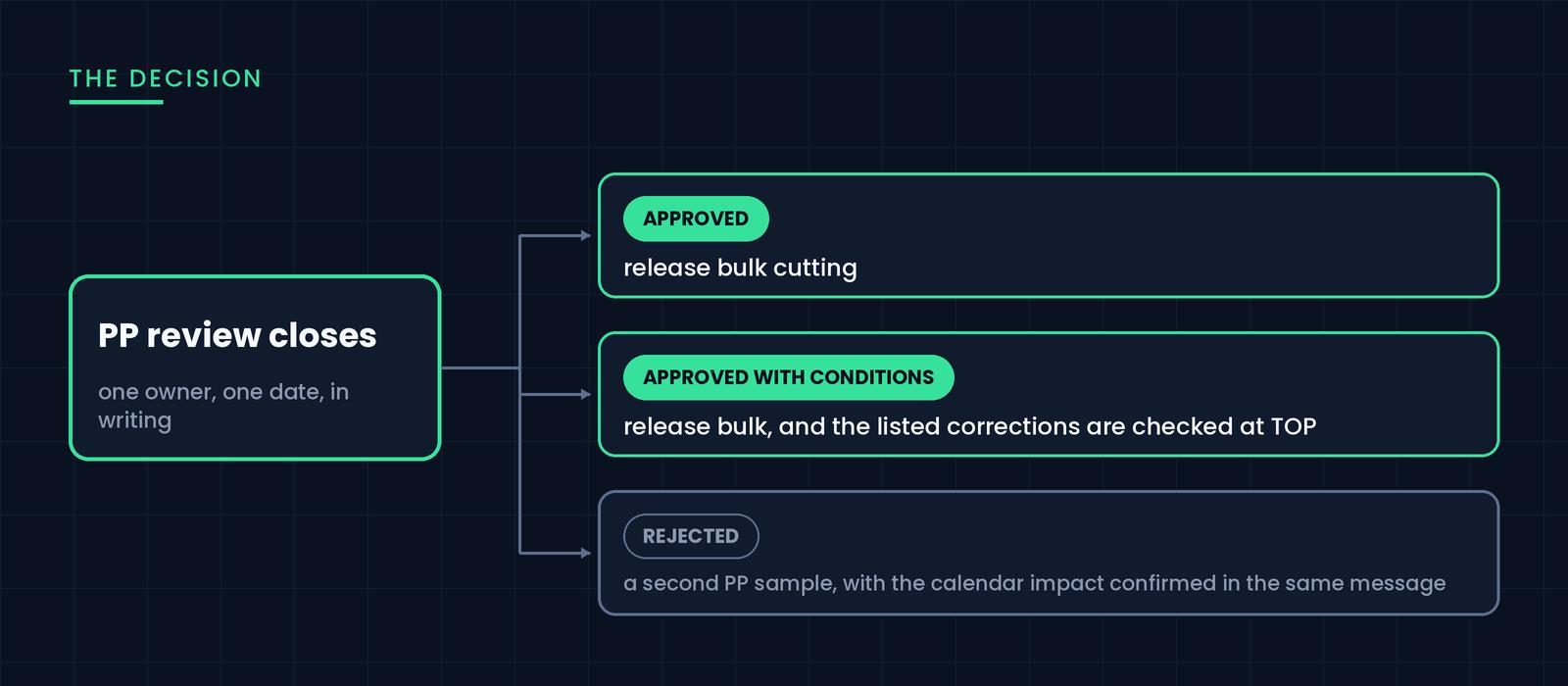
5. Record a single decision with an owner and a date. Approved means release bulk. Approved with conditions means release bulk, with a listed set of corrections that must appear at TOP. Write that list somewhere structural, because conditions left in a comment stream are conditions nobody checks. Rejected means a second PP sample is required, and you should say what has to change and confirm the calendar impact in the same message.
6. Push every accepted correction into the tech pack, then close the round. The factory works from the specification, not from your review notes. A correction that never reaches the spec is a correction that reappears at TOP. Update the spec first, change the workflow status second, so the record and the document agree.
Common Reasons PP Samples Get Rejected
Most rejections trace to something upstream, not to the factory.
Substitute materials. The bulk fabric wasn’t ready, so the factory sewed in something similar to keep the calendar. Drape, weight, and shrinkage all shift, and the measurements come back out of tolerance for reasons that have nothing to do with the pattern.
Spec drift. The fit round produced corrections that were agreed in conversation and never written into the tech pack. The factory built what it was given.
Grading problems at the size extremes. The base size measures perfectly. The largest size doesn’t, because the grade rules were never validated past the middle of the range.
Unresolved fit comments carried forward. A fit round closed ambiguously, the open item was assumed handled, and it arrives unhandled with only one round left.
Late compliance requirements. A market-specific label or content requirement surfaces after the sample was made, and correcting it changes construction.
Four of those five are review-process failures, not manufacturing failures. That’s the argument for closing every earlier round with a recorded decision instead of a quiet thread. The full workflow is here: digital sample review and approval.
Can You Run a PP Review Remotely?
Partly, and the split is fairly clean.
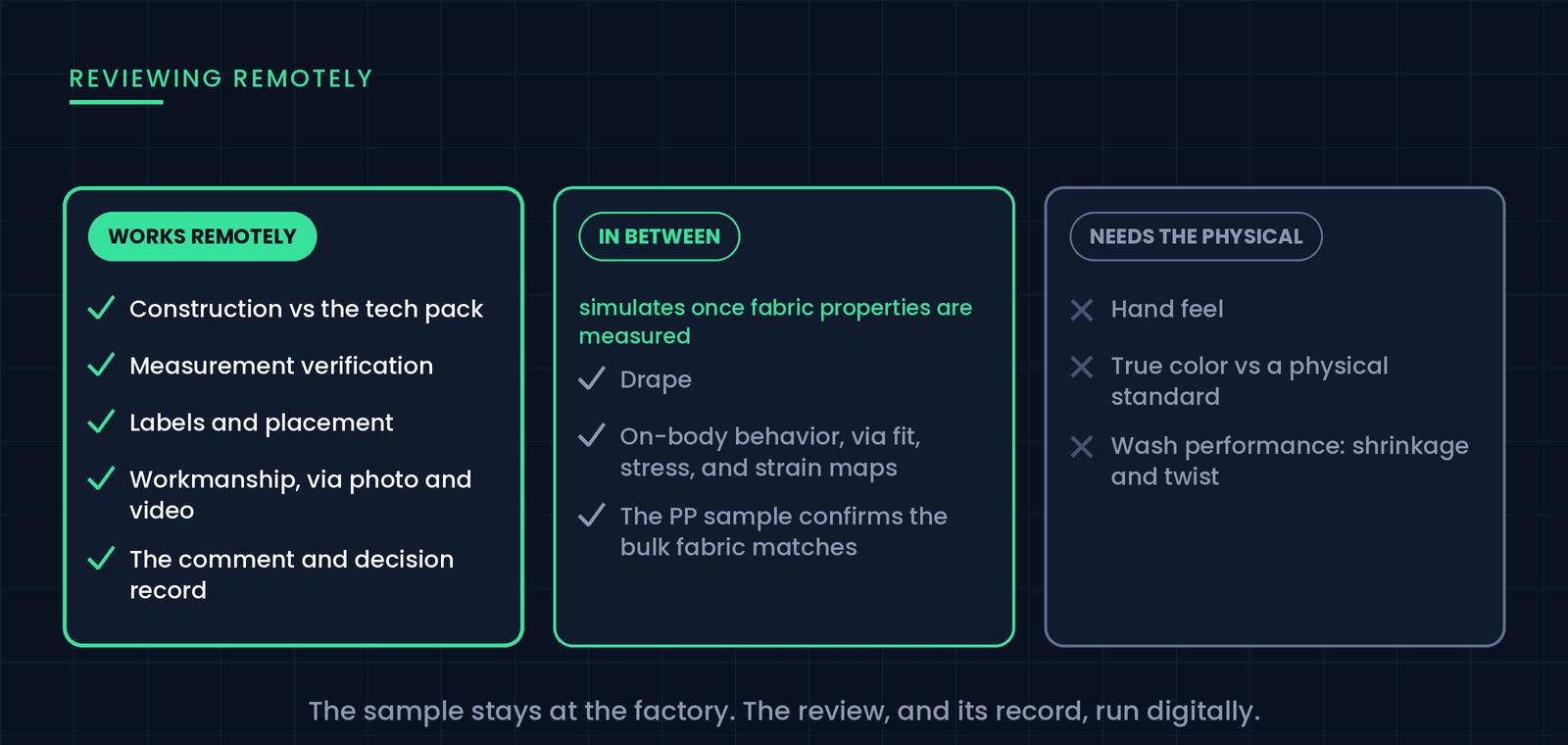
Works remotely: construction conformance against the tech pack, measurement verification (with the factory measuring on a shared, structured sheet and photographing the tape in position), labeling and placement, print and graphic placement, workmanship inspection through detailed photography or video, and the entire comment and decision record.
Doesn’t work remotely: hand feel, true color against a physical standard, and wash performance, because shrinkage and twist after laundering come out of physical testing, not simulation.
Drape and on-body behavior sit in between. Both simulate reliably when the fabric’s physical properties are measured rather than estimated: accurately enough to make drape and fit calls on screen, with fit, stress, and strain maps showing where a garment pulls or strains on the body. What the physical PP sample adds is confirmation that the actual bulk fabric behaves the way its digitized version predicted.
The practical arrangement most teams land on: the physical PP sample stays at the factory and a duplicate ships to the brand, while the review itself, meaning comments, measurements, and decision, runs digitally so every participant is looking at the same record. That way the round doesn’t wait on a courier, and the approval history exists somewhere other than an inbox.
How CLO-SET Handles This
CLO-SET gives the PP round a single place to live. Sample photography, measurement records, reference 3D garments, and the tech pack sit together on the same Style inside a shared Room.
Each round arrives as a new version of that Style instead of another file, so a comment stays bound to the sample it described. Feedback splits into Annotation for notes pinned to a point on the garment, exportable to PDF so the factory gets the markup alongside the spec, and Comment for threaded discussion with attachments. The decision is recorded by changing the style’s Workflow Status, using stage names each company defines in Company Settings, so “PP approved” means the same thing to everyone. Each colorway carries its own Status alongside it. Vendor access is set with Permission at Space, Room, or Style level, so the factory participates without a CLO license and without receiving your editable files. Measurement tracks 2D and 3D measurements against target measurements, which is the part of a PP review that most often gets retyped into a spreadsheet, and the Web Tech Pack (BOM, POM, Construction, and Cost Estimation) carries the spec through the production stages so accepted corrections reach the document the factory actually works from.
The materials question doesn’t have to wait for a courier either. With CLOFAB, the fabric digitization tool built into CLO-SET, a supplier can digitize the actual bulk fabric before the PP sample is sewn: scan a swatch with the CLO zFab Kit, or start from a fabric image where there’s no hardware on site, then enter the composition, weight, and thickness and the drape is computed from the specs. It runs in the browser with no CLO license and no installation, which keeps the barrier low for suppliers still new to 3D. The digitized fabric lands in the Workroom or Company Library, so the 3D garment the team reviews ahead of the PP round is wearing the fabric the order will actually use. Hand feel and true color still belong to the physical sample. What moves earlier is everything fabric-driven that can be judged by eye: drape direction, weight behavior, and how the approved material sits on the garment.
The effect tends to show up as fewer rounds rather than faster ones. APG & Co, the Australian group behind Saba, Sportscraft and Jag, reported a 50% reduction in development and fit sampling costs in FY25, with 100% of styles across the three brands managed on CLO and CLO-SET and 10 supplier factories onboarded. Their framing of what changed is the useful part for a PP round: physical samples became confirmations rather than experiments. Those results were assessed externally, earning the group a Best Use of Technology finalist place at the 2026 Australian Fashion Industry Awards. Read the full story.
FAQ
What is the difference between a fit sample and a pre-production sample?
A fit sample tests the pattern, covering base-size measurements, balance, and how the garment sits on body, and it can be made by any competent sample room. A pre-production sample tests the factory: it must be sewn by the facility that will produce the order, using approved bulk fabric and trims, to prove the garment is manufacturable to spec there. Fit is a pattern question. PP is a manufacturing question.
What is the difference between a PP sample and a TOP sample?
A PP sample is sewn before bulk production starts, to prove the factory can build the garment to spec in bulk materials, and approving it releases bulk cutting. A TOP sample, or top of production, is pulled from the bulk run itself, to confirm production output matches the approved PP sample, and approving it releases shipment. PP asks whether production may start. TOP asks whether what was produced matches what was approved.
How long does pre-production sample approval usually take?
The review itself is short, a few hours of technical work. The calendar cost is in the loop around it: waiting for bulk materials, shipping the sample, collecting comments from several functions, and returning a consolidated decision. Teams that shorten PP approval do it by compressing the feedback loop, not the inspection, which is why the round is a common candidate for digital review.
Can you skip the pre-production sample?
Occasionally, on a repeat carryover style at a factory with an established quality record and no material changes. On anything new, whether that’s a new style, factory, fabric, or construction, skipping it means the first bulk-materials, bulk-line garment you see is the production run itself. The saved week is generally cheaper than the rework it risks.
What does “approved with conditions” mean on a PP sample?
It means bulk is released, but named corrections must be present at TOP. It only works if the conditions are recorded somewhere structural, with an owner, and actually checked at the next round. Conditions left inside a comment thread are the most common way a known defect reaches production.
Does a PP sample need to be in final packaging with final labels?
Labels yes. Care, content, size, brand, and origin marking should all be present and correctly placed, since labeling errors are expensive to discover after goods are finished. Packaging is usually verified separately, often at TOP, but confirm which your buyer or market requires rather than assuming.
Who is responsible if bulk is cut against a PP sample that was wrong?
Contractually it depends on the terms. Practically it depends on the record: which sample was reviewed, what was decided, who decided it, and whether the corrections reached the tech pack. Disputes are settled by that record, which is the strongest argument for keeping version history and decisions in one system rather than reconstructing them from email.
Continue lendo
Ver tudoTop 5 3D Product Collaboration Tools for Fashion Brands (2026)
Ask a fashion team why they’re looking at 3D collaboration tools and the answer is rarely about 3D. It’s about the Tuesday a vendor built a sample from the version that got superseded on Monday, or th

3D Sample Review vs Physical Sample Rounds: Cost, Lead Time, and When You Still Need the Real Thing
The pitch for 3D sampling usually overshoots. Somebody demos a garment rotating in a browser and the conclusion lands as “we can stop making samples,” which isn’t true and sets the project up to be ju
Digital Sample Review and Approval: A Complete Workflow for Fashion Teams
A fit sample lands on the desk. Someone photographs it against a white wall, drops four images into an email, and writes "shoulder looks off." Three days later the vendor replies asking which shoulder