New in CLO-SET: AI Visualizer Turns Your 3D Garments into Photorealistic Fashion Images (Beta)
Every 3D designer has hit this moment: the garment looks right in the viewer, and the person you need to convince wants to see it on a street, on a body, next to the bag it will be sold with. Until now that meant a render setup, a photoshoot, or asking them to imagine it.
 Every 3D designer has hit this moment: the garment looks right in the viewer, and the person you need to convince wants to see it on a street, on a body, next to the bag it will be sold with. Until now that meant a render setup, a photoshoot, or asking them to imagine it.
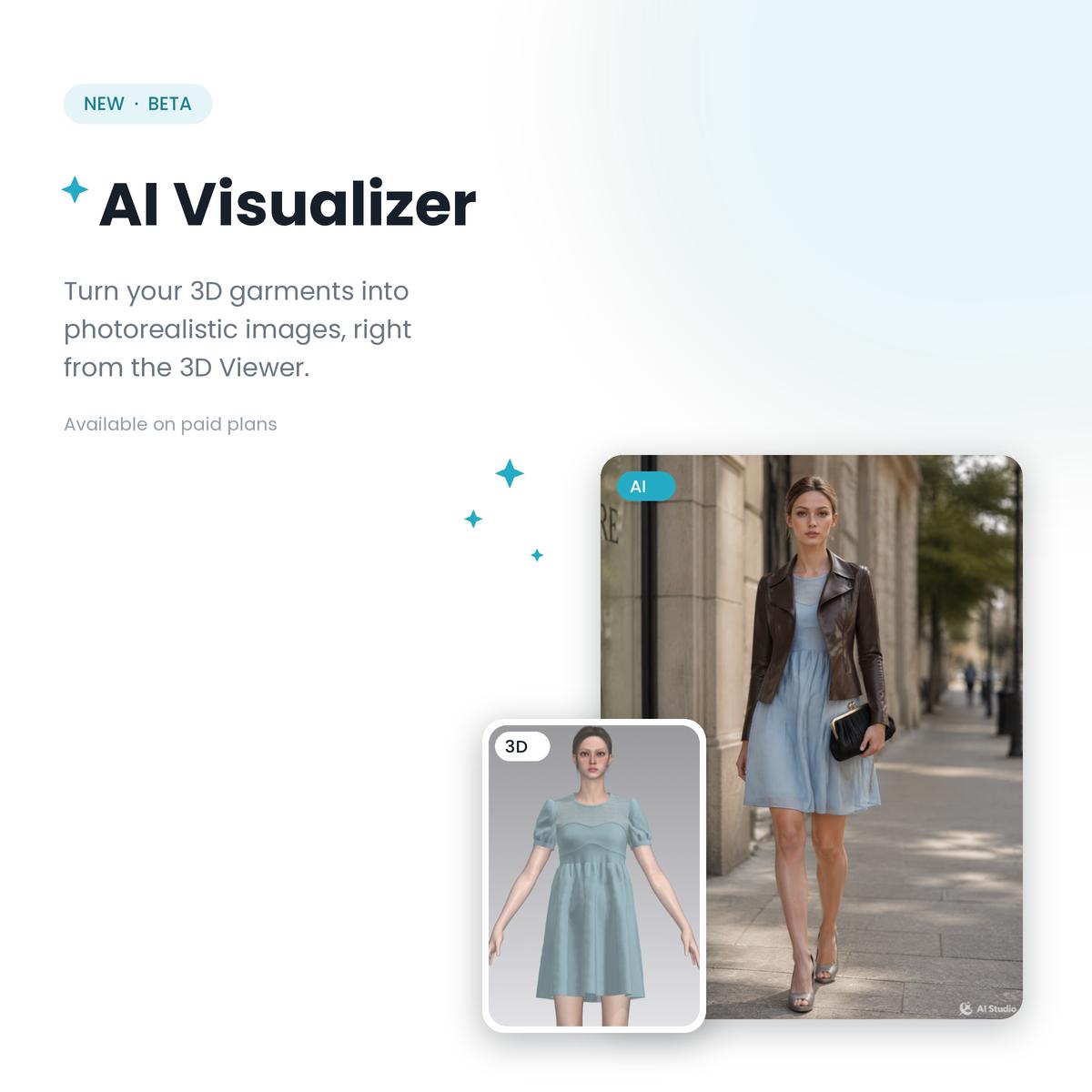
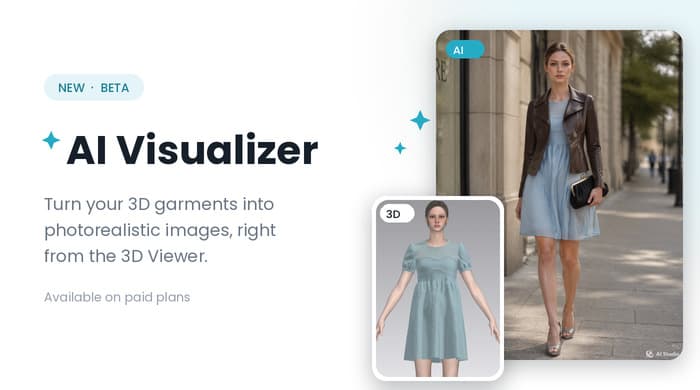
AI Visualizer, now in Beta on CLO-SET paid plans, closes that gap. It takes the 3D garment you already built and generates photorealistic images of it: on a model, in a scene, styled with pieces that may not even exist as 3D assets yet. The AI supplies the model, the light, and the street. The design still comes from you.
TL;DR
AI Visualizer generates photorealistic fashion images from the 3D garments in your CLO-SET workspace, straight form the 3D viewer.
Unlike AI image generators that create clothing from a text prompt alone, it starts from your actual garment, so the design in the image is yours.
Reference assets can join the shot: other 3D garments from your workspace, or plain photos of shoes, bags, and trims that have no 3D version yet.
It runs on GPT Image or Gemini, with style presets, an avatar face lock, and a transformation strength control for refining results step by step.
What is AI Visualizer?
AI Visualizer is an AI fashion image generation tool built into the CLO-SET 3D Viewer. Open any garment on its Content Page, click the AI Visualizer button, and the garment becomes the base of a photorealistic image: a street shot, a runway look, a cinematic scene, whatever you describe in the prompt or pick from the presets.
This is a different job from most AI fashion design tools. A text-to-image generator imagines a garment for you, which is where many teams start their ideation. AI Visualizer works from the other end: the garment is real, designed and simulated in 3D, and the AI builds the world around it. Your design decisions survive the trip.
How it works
Start from your garment. The 3D garment in the viewer becomes the Base image. Don’t stop at one look: colorways you built carry over, so each variant can get its own shoot.
Add what the shot needs. Up to 8 reference assets join the generation: a jacket pulled from your workspace as a 3D asset, or a simple photo of the shoes and bag the look will be styled with. This is the part teams will feel first, because the accessories that complete a look often exist only as supplier photos.
Describe it and generate. Pick an engine (GPT Image or Gemini), choose a preset like Street Fashion or Runway, or write your own prompt. Preserve avatar face keeps your model consistent across shots. Results land in a Generated panel, ready to save or download.
Refine instead of rerolling. Use current image as base turns any result into the next starting point, and AI Transformation Strength controls how far the AI moves from it: keep the structure and touch up details, or allow a stronger restyle.
Where it fits in your workflow
A styled, photorealistic image answers questions a gray-background viewer can’t: does this look sell as an outfit, does the colorway read at street distance, is this the story for the lookbook. Teams get to those answers before a sample is sewn or a photoshoot is booked, which is where AI Visualizer earns its place in a digital sample review.
None of this replaces your eye. It gives your eye more to look at, earlier.
It also sits deliberately alongside two features you may already use. Render stays the tool for images faithful to the garment exactly as simulated, and mix&match styles the 3D assets already in your workspace. AI Visualizer covers the exploratory step: how the style could look in the world, with pieces that are not 3D assets yet.
AI Visualizer is available now in Beta on paid plans. Open any garment’s 3D Viewer to try it, and see the Feature Manual for the full walkthrough.
FAQ
Can AI generate fashion images from a 3D garment?
Yes. AI Visualizer in CLO-SET uses the 3D garment as the base of the generated image, so the design, silhouette, and colorway in the result are the ones you built. The AI generates the model, scene, and styling around the garment.
How is this different from an AI fashion design generator?
Text-to-image fashion generators imagine new garments, which suits ideation and moodboarding. AI Visualizer does a different job: it photographs a product that already exists as a 3D asset, so the image can support decisions about that actual style.
Which AI engines does AI Visualizer use?
GPT Image or Gemini, selected per generation. Style presets, a custom prompt field, an avatar face lock, aspect ratio control, and a transformation strength setting shape the result.
Is AI Visualizer available on the free plan?
No. AI Visualizer is a Beta feature available on CLO-SET paid plans. Generated images are visible to the members of the group the content belongs to.
继续阅读
查看全部CLO-SET 全新功能:CLOFAB,您的内置面料数字化工具
精准的数字面料是每一款可靠 3D 服装的基础——且在供应链中的每一个人都应该能轻松构建它们,而不仅仅是 3D 专家。 今天,我们在 CLO-SET 中正式推出 CLOFAB :这是一款基于网页的面料数字化工具,让您直接在浏览器中即可创建、注册并共享数字面料资产。无需安装额外软件,也无需 CLO 许可证。使用由 AI 驱动的 CLO zFab面料测量套件(CLO zFab Kit) 扫描实体样布,或者直接使用您现有的面料图像——无论哪种方式,CLOFAB 都能在几分钟内将其转化为可用于模拟的数字面料。 无论您是为买家构建数字资源库的面料厂、响应数字化需求的供应商,还是对当季材料进行数字化的品牌方,CLOFAB 都能在您团队已使用的平台内无缝运行。 为什么我们将 CLOFAB 内置于 CLO-SET
如何通过实用的 3D 工作流技巧优化时尚产品开发 - 2026 CLO-SET Webinar
时尚产品开发不仅仅是创建 3D 服装。随着团队在设计、开发、商品企划和生产等环节的协作,高效的工作流对于减少手动操作和加速决策变得至关重要。 在我们的 第 10 期 CLO-SET 技能进阶在线讲座 中,我们探讨了有助于简化产品开发流程各个阶段的实用技巧和效率功能——从整理产品信息和创建样衣,到评审系列和衡量开发绩效。 在全球场次之后,我们还针对多个地区举办了本地化讲座,让用户能够以首选语言学习这些工作流。所有讲座的录像现已上传至 CLO-SET YouTube 频道 ,您可以随时回放并探索完整的演示内容。 以下是本系列讲座中涵盖的一些核心工作流优化亮点。 核心要点 在设计开始前建立结构化的产品基础 在创建样衣时更高效地查找和复用资产 利用 AI 驱动的协作工具加速样衣评审 标准化系列评审和商品企划工作流 通过切实可行的数据分析衡量产品开发绩效 1. 建立更好的产品基础
CLO-SET 2026年第二季度更新:更优的产品审阅,更智能的工艺单
从产品审阅到生产文档,第二季度的更新旨在帮助时尚团队更高效地沟通、更自信地审阅产品,并准备更完整的技术文档。 一起来探索 CLO-SET 的全新功能。 [产品评审与协作] 产品评审通常涉及与供应商的沟通、反复修改和持续的质量检查。本季度推出的新功能将帮助团队简化产品沟通和评审工作流程。 使用虚拟展厅简化产品请求 在整个产品开发流程中,虚拟展厅为您提供了一种更高效的方式,以便与供应商和业务合作伙伴进行沟通。 通过“ 添加到清单 ”与“ 发送邮件请求 ”功能,用户可以选择多个款式,并直接从虚拟展厅发送产品请求,从而能够更轻松地在单一工作区内集中管理产品沟通。 借助 AI QC Bot (测试版) 加速质量评审 跨多个产品评审质量结果通常非常耗时。 AI QC Bot (测试版) 能够自动分析检测到的质量控制数据,并总结 3D